


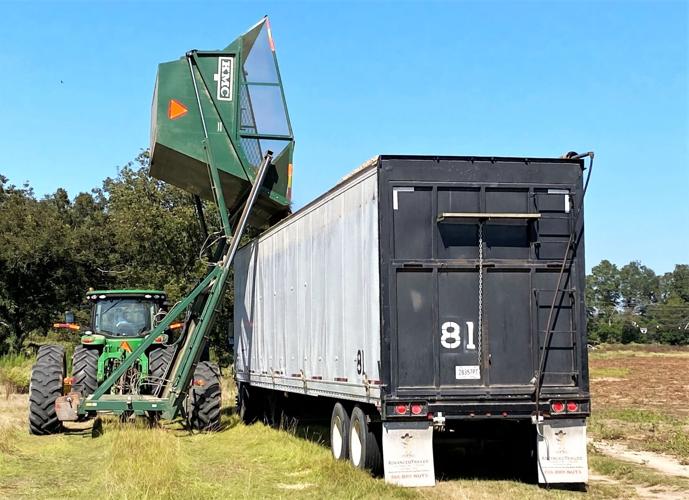


Mother Nature smiled on Calhoun County farmers in 2022 with an abundance of moisture that boosted crop yields.
High input costs, however, took a bite out of potentially larger profit margins.
"Abundant rainfall, similar to 2021, helped crops with their yield potential," Calhoun County Clemson Extension Agent Charles Davis said. "Only one extreme heat wave punished Calhoun County crops, but it only affected corn yields."
"Farmers' biggest battle this year was with their checkbooks," Davis said. "Production costs, mainly fertilizer prices, skyrocketed. Fortunately, markets and yields held, and it appears that most farmers will come out in decent shape at the end of the year."
One likely impact of high input costs was a reduction in plantings for 2022.
"Calhoun County farmers planted 3,000 fewer acres this year than 2021 due to the deletion of marginal farmland," Davis said.
People are also reading…
Despite challenging times on the farm, Davis said agriculture remains the primary industry in Calhoun County, with 40,000 acres planted in the four major crops, corn, cotton, soybeans and peanuts.
Jeffrey Kaigler, who farms in Calhoun County, grew about 650 acres of corn, 300 acres of peanuts, 250 acres of cotton and 250 acres of soybeans in the county.
Kaigler also has fields in Orangeburg, Lexington and Dorchester counties.
The story for 2022 was the "high cost of inputs," Kaigler said.
"What has been the biggest hit for us is the cost of production we are paying for right now, Kaigler said.
"The high cost of everything we are doing is just killing us," he said. "Fertilizer costs were extremely high this year. That was the biggest thing is fertilizer."
"I have never seen fertilizer this high," he said. "We have to have it to make a crop."
"I don't know what will come in 2023 but we are hearing it is going to be no better than this year and that it might be more," Kaigler said.
Kaigler said there were also some "close calls" related to getting the needed equipment parts on time. He said he did get parts on time but said they have to be shipped across country and the supplies are low.
High input costs come with fluctuating commodity prices.
Kaigler said cotton prices were as high as about $1.20 a pound but have fallen to the middle 80-cent range.
"It needs to be back above $1 to pay for these high input costs," he said.
In order to save on inputs, Kaigler consolidated tasks.
"We have consolidated everything we can consolidate," he said. "A crop has to have certain fertilizer to produce."
"We cut about all we can cut," he said.
When assessing his overall year, Kaigler is hoping to be able to come out in the black.
"It is not all said and done," he said. "We have to get the crop out of the field. Hopefully we will be pleasantly surprised at the end of the harvest. Hopefully we will get an opportunity in the market and sell at a better price than we got now."
Monty Rast, who farms in both Calhoun and Orangeburg counties, grew about 300 acres of peanuts in Calhoun and 200 acres of peanuts n Orangeburg County. He grew about 1,000 acres of cotton in Orangeburg County, plus 150 acres of corn. His crops were irrigated.
"We are having a banner peanut year," Rast said. "Yields are excellent in this area."
Rast says an average of about 4,500 pounds per acre on peanuts is what he is expecting. He was about halfway through the harvest at the time of this writing.
"Corn yields were good," Rast said. "It was about 200 bushels per acre and cotton yields two bales plus."
Rast said he was about 10% done with cotton at the time of this writing.
Rast said there were at least two noteworthy stories for farmers in 2022.
One was Hurricane Ian.
"The hurricane came through without a big event," Rast said. "We were lucky there. Everybody was very fortunate. There was some wind damage to the cotton but everything else went well. The center went north of us the heavy winds were on the north side."
Rast echoed Kaigler regarding inputs.
"Everybody is fighting these high input costs," Rast said. "Fuel, labor, everything. People are struggling with that."
Rast said the "jury is still out" on whether the average farmer will end up with some money in the pocket.
"I think yields are going to probably be okay to meet that challenge but anytime you have a yield break or some problem or weather issue, those input costs are not going to change. That is when you have trouble."
Rast said the cotton market was strong all year long and then has fallen off recently.
"You got to deliver," Rast said. "The difference in the peanut contact is we have an act-of-God clause: If you don't make them, you don't have to deliver them."
"In a cotton or soybean booking, you got to deliver," Rast said.
Rast said another thing he has done is diversify into sod and red corn that has been sold in Charleston.
"These are specialty markets," he said. "People are growing vegetables, greens and peanuts. People are diversifying a lot."
Cotton
Cotton acres were nearly identical to 2021, with 21,900 acres of cotton planted in Calhoun, Davis said.
"The crop benefited from the above-normal rainfall and did not suffer from the June heat wave to the extent corn did," Davis said. "Input costs for cotton were up about 20%, similar to corn."
"Again, opportunities to price cotton above $1 per pound were available to producers and this helped to offset the higher production costs," Davis said.
Davis said the biggest issue for cotton was Hurricane Ian. The storm caused the loss of several hundred pounds of lint, reducing what was an outstanding cotton crop to a mediocre one.
"It is unknown at this time if financial assistance will be available to farmers to cover these losses," Davis said.
Kaigler said the upper end of Calhoun County from about U.S. 601 to Columbia, where he grows most of his crop, was generally spared from the impact of Ian.
"We had limited damage in cotton," Kaigler said, adding that he had about 2-1/2 inches of rain at his farm.
At the time of this writing, cotton harvest had just begun and yields were unknown.
"Early reports before the hurricane indicated a solid 1,000-pound crop, but those early reports do not necessarily reflect the bulk of the acreage or the losses from the storm," Davis said.
For most of the growing season, cotton has been selling over $1 per pound, even reaching as high as $1.20 a pound. The price for cotton has since fallen into the 80-cent-a-pound range.
Insect pressure included the normal pests, mainly stinkbugs and thrips, Davis said.
"Some target spot and mildew disease was found, but in general, it was not a bad disease year," Davis said.
Corn
Corn acreage was 7,700, down from 8,900 in 2021.
Davis said corn production benefited from a relatively wet year with the months of April through September seeing 29 inches of rainfall or 5 inches above normal.
"Temperatures averaged slightly below normal, but May saw temperatures average 2.4 degrees above normal," Davis said. "The higher temperatures in May, June and July, along with numerous cloudy days, affected corn yields, despite the above-average rainfall."
As a result, Davis said irrigated corn yields were off by 20 bushels, averaging about 170.
"Dryland corn yield was significantly reduced, and in some cases was zero in some fields caused by a heat wave in mid-June that had six days of temperature over 95 degrees with no rainfall," Davis said.
Dryland yields ranged from 100 bushels to zero, depending on the soil and location, Davis said.
Kaigler echoed that sentiment.
"Corn, dryland was off," he said. "We had dry and hot weather that hurt the crop. It hurt both the irrigated and dryland corn."
Davis said prices were the bright spot that counteracted the sharp rise in fertilizer and other input costs.
"There were opportunities to contract corn at $7-plus per bushel," Davis said. "While this addresses production costs, it remains uncertain if the higher prices for commodities had enough strength to offer farmers a profit at the end of the year."
The crop was relatively insect and disease free in 2022, Davis said.
Peanuts
Acreage was up slightly from 2021, with 8,900 acres planted, Davis said.
"Peanuts have fared well this year, benefiting from the summer rainfall and not being hurt by the June heat wave," Davis said. "While peanuts did not suffer from higher fertilizer prices, other inputs increased production costs by over 10%."
Davis said yields for peanuts were solid -- in the 4,000-pound range for both dryland and irrigated. At the time of this writing, only half of the peanut crop had been harvested, meaning yield numbers are subject to change.
"Contract prices for peanuts were above $500 per ton this year, which hopefully will be enough to offset some of the increased production costs," Davis said. "The bottom line is that farmers will probably not see peanuts being more profitable this year than last year."
Davis said the usual diseases of this year’s crop were late leaf spot and white mold.
"There were no major outbreaks, just normal sustained pressure," he said. "Insect pressure was light."
Kaigler said Calhoun County peanuts look "pretty good," though he had not gotten any yield numbers on the crop as of this writing.
He has harvested about 250 acres of peanuts that are fair to average.
Soybeans
Soybeans continue to be a minor crop in Calhoun County, with only 3,100 acres planted, nearly identical to 2021, Davis said. The crop is a poor rotation with peanuts.
"The June heat wave did not affect soybeans, but they benefited from the above-average rainfall," Davis said. "Harvest is just beginning, but an above-average crop is expected with yields averaging 40 bushels or above."
Overview
According to 2017 Census of Agriculture data, Calhoun County is home to 480 farms, consisting of about 148,718 acres. The average farm size is 310 acres.
The number of farms has increased from 412 in 2012 and the average farm size has also increased from 287 acres.
Overall, Calhoun County ranked 16th in the total market value of crops, livestock and poultry sold at $80.8 million.
The county has a total of 309 cropland farms totaling 79,945 acres.
Calhoun County ranked fifth in the state in the market value of crops sold at $59 million, according to the 2017 USDA Census.
The county ranked second in cotton sold at $18.7 million and second in other crops and hay at $16.2 million.
The county's largest crops in planted acres in descending order are cotton, peanuts, corn and soybeans.
The agricultural census is taken every five years.
According to the United States Department of Agriculture National Agricultural Statistics Service, the census will be mailed out to farmers in November 2022 with a response deadline of February 2023.
The census data will be released in the spring or summer of 2024.
In this Series
2022 T&D Fall Farming Edition: Harvest time in S.C.'s breadbasket

Gene Zaleski
T&D Staff Writer


