


Tough.
The word sums up the Orangeburg County 2022 growing season for farmers from Springfield to Eutawille, according to Orangeburg County Clemson Extension Agent Jonathan Croft.
"Weather-related issues, increased input cost and labor shortages were some of the biggest issues," Croft said.
Mother Nature is often the wild card in agriculture but in 2022, as in the previous two years, COVID was not quite done with rearing its ugly head on farming.
It started in 2020, continued into 2021 and into 2022.
"Ongoing disruptions in the supply chain, increases in input cost and shortage in trucking have negatively impacted farms by delaying repairs or arrival of inputs,' Croft said. "It has limited and increased the cost of moving farm products.
People are also reading…
On the Mother Nature side, Croft said corn at this point appears to have suffered the most.
"A late frost did injure some early-planted corn and caused some acres to be replanted," Croft said. "Dry, hot weather has impacted crops this year across much of the region. Hardest hit by dry, hot conditions was the corn crop."
Orangeburg County Farmer Harry Wimberly -- who grew about 100 acres of dryland corn and 300 acres of irrigated corn, 1,000 acres of cotton, 100 acres of peanuts and 300 acres of soybeans -- said generally his crops were about average.
"The biggest burden and the highest hurdle is our input costs skyrocketed this year," Wimberly said.
Commodity prices also were higher than they have been in recent history.
Earlier in the year, cotton prices were about $1.20 a pound, even getting a little bit higher before falling to a mid-October price-point level of about 84 cents a pound.
"The cost of production is still holding up there," Wimberly said.
Wimberly said the price drop from the high to the low means about $200 lost per bale of cotton.
"That can be a substantial amount of money when you got a lot of cotton," Wimberly said. "It's just beyond our control."
Some local farmers adjusted their operations to offset higher costs, including the cost of fuel and fertilizer.
In July, Providence farmer Dean Hutto of Hutto Brothers Partnership said, "We have just tried to be more efficient and cognizant of where we planted what and trying to make less trips across the fields."
“We have had to be smart with fertilizer, but we have to have it," he said.
Hutto planted about 1,200 acres of corn, 425 acres of peanuts, 700 acres of cotton, 800 acres of soybeans and 450 acres of wheat.
The biggest challenge for Hutto, in addition to high input costs, was supply-chain issues.
"We have been waiting on a part since mid-May and a tractor we ordered in June 2021 that was supposed to be here in February 2022 still has not arrived," he said. "It is still an ongoing issue, especially with parts."
Hutto said high inputs did come with "fair" commodity prices, "except cotton."
The combination made for a challenging year.
"They (inputs) are still exponentially high compared to previous years and even with fair prices, the inputs are too high for what we receive," Hutto said.
Frog Level Farm row crop farmer Jim Traywick in Cope grew cotton and corn and said overall, "it has been a good year for us."
"We just had enough rain, though it was very dry in May, so we had trouble getting things planted. But after that it got better."
Traywick echoed the fact that inputs are up.
"We can see a 20% across-the-board increase in inputs," Traywick said, though he said increases in commodity prices helped. "It will be a good year. It may be the best cotton yield we have ever had and it certainly was the best price we have ever had."
Corn was also selling about $7 to $8 a bushel and soybeans were between $13 and $14 a bushel.
"The value of a dollar is high compared to the rest of the world," Traywick said. "The value of a dollar will hurt the export of cotton and corn to a certain extent. The value of the dollar is coming into play that makes it hard to export."
As the year went on, some inputs did stabilize somewhat but continued to remain high.
Fertilizer prices did not increase from the winter/spring through the early summer. The price of urea, one of the nitrogen components in fertilizer blends, was also down in early summer.
Other nitrogen components associated with petroleum remained high because of oil prices. Potassium stabilized and phosphorus prices came down slightly in early summer.
Transportation costs remained high, keeping prices high. Fuel prices through the early summer remained high but then tailed off some later in the summer but began picking up once again at the time of this writing.
The high fuel costs prompted farmers to look for ways to minimize trips across the field. One of the strategies was to mix as many crop-protection products as they can safely mix together in one tank in order to capture crops in one trip.
Pesticide costs remained pretty stable during the spring planting season. Generally speaking, the average farm saw about a 15% to 20% increase in pesticide costs this year.
Croft said looking ahead to 2023, it could be more of the same.
"It appears at this time that row crop production in 2023 is going to continue to see increases in cost of inputs, especially pesticides and fertilizer," he said.
It has been a challenging time for farmers over recent years.
In 2015, farmers had to deal with the historic flood, and in 2016 Hurricane Matthew made its presence felt.
Then in 2018, Tropical Storm Michael brought gusty winds and heavy rains, damaging some of the cotton crop and delaying the harvesting of peanuts.
This year Hurricane Ian dropped between an inch and 5 inches of rain and brought with it some gusty winds at the end of September. The storm's impact, however, was less than feared as winds were not severe and rains came in and left quickly.
Knowing the storm was coming, peanut farmers scrambled to get crops out of the fields before the storm hit.
The storm's impact was generally less severe locally than many had feared.
Despite challenges, Croft said agriculture continues to be a leading industry in Orangeburg County and employs a lot of residents.
"At this point it is difficult put a value on the crops grown this year as growers are in the middle of harvesting crops," Croft said. "... Corn, soybeans and cotton prices are up compared to 2021 prices, however, inputs cost also went up and overall cost of production is at a point that turning a profit is difficult without a great crop yield."
Corn
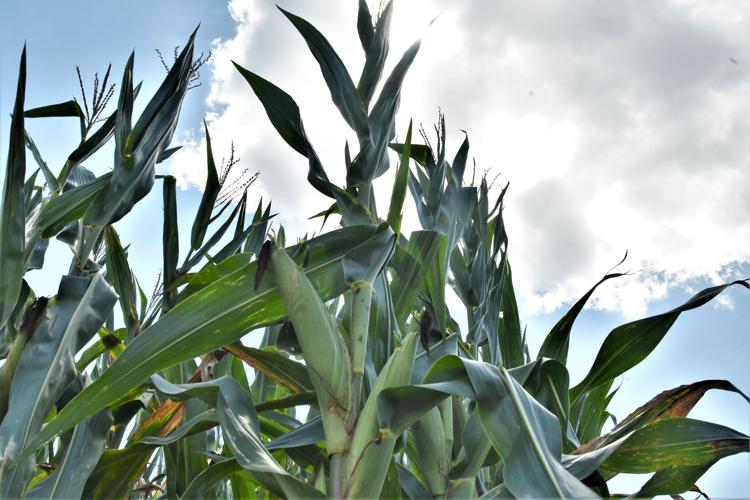
Croft said corn acreage decreased significantly in 2022 as compared to 2021. In 2022 approximately 28,000 acres of corn were planted. Last year, there were approximately 40,000 acres.
"Yields were off this year compared to the average, especially on dryland corn across the county," Croft said. "Some areas in the county, there were fields zeroed out and destroyed."
"Overall I am estimating yield will be about 65 to 70 bushels per acre when averaging across the whole county," Croft said. "Irrigated corn was also below average and I estimate it is going to be in the 200 to 225 range across the county."
"Our corn crop -- the dryland -- was hit hard by the heat and the drought," Wimberly said. "Dryland corn was pretty sorry."
Wimberly said irrigated corn was about average, though it too suffered from dry and hot conditions.
Hutto said about 650 acres of his corn was irrigated and it was an above-average crop.
"Dryland was down some due to drought and the irrigated was what it normally is," Hutto said. "Drought in June hurt it."
Last year, dryland corn averaged about 125 bushels per acre. Irrigated corn last year was also better with an average yield of about 240 bushels per acre.
Early-planted corn this year was hurt by late frost and then hit by dry, hot conditions during tassel/grain fill, Croft said.
Croft said it was not all gloom for corn.
"The late-planted corn was helped by timely rainfall from summer thunderstorms and late-planted corn was better yielding than early-planted," Croft said.
Prices are good and at the time of this writing, corn prices were $6.92 per bushel. That is up from 2021 but profit margins were thin due to increased cost inputs.
Insect and disease pressure was average, Croft said.
Peanuts
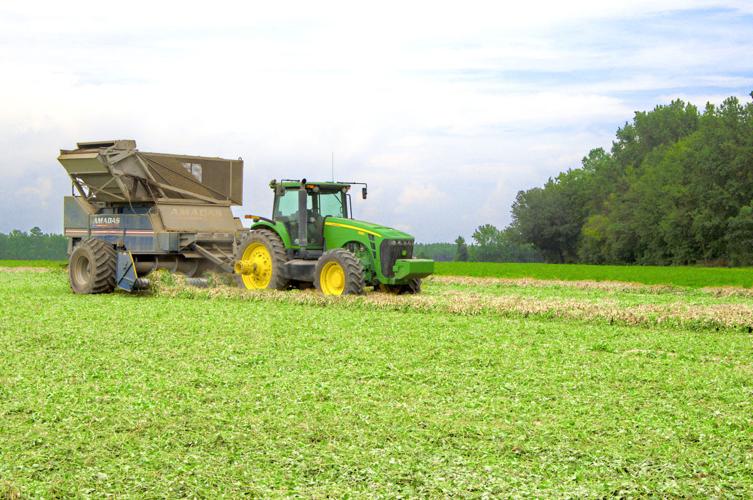
Peanut acres were down compared to 2021. In 2022 approximately 9,000 acres were planted across the county, Croft said. About 11,000 total acres of peanuts were planted in 2021.
Croft said peanuts were still being harvested but an early indication is that "yields appear to be average to below average."
"Hot dry weather during the early part of growing season impacted early pod set," Croft said. "Dry conditions also hurt the wash in of soil fungicides."
Croft said there were some timely rains for peanuts that did help the crop during mid-summer.
"Also great harvest conditions helped growers get a lot of peanuts harvested before Hurricane Ian made landfall," Croft said.
For irrigated peanuts, farmers like to see yields typically in the 5,000 to 6,000-pounds-per-acre range. For dryland peanuts, farmers would like to see yields in the 3,500 to 4,000-pounds-per-acre range. Last year, the crop had above-average yields.
Though inputs costs are among the highest seen in recent memory, typical yield has tended to trickle upward.
Peanut production costs were also up due to an increase in pesticide cost and fuel cost.
"Increased input cost did make it challenging for growers," Croft said.
Contracts were approximately $500 per ton for peanuts. Prices last year were running at about the $525-a-ton range.
Wimberly said peanut picking had just begun and the jury is still out on the crop's yields or grade.
At Hutto's farm near Holly Hill, "peanuts have been above average so far.
"I am very pleased with the crop," he said. "We had good growing weather on the peanuts and relatively favorable harvest weather."
Unlike corn, peanuts did see some insect pressure in 2022.
"Damage from thrips early in the season was higher this year than last year," Croft said. "Some areas also saw an increase in damage from foliage feed caterpillars this year."
The crop also suffered from some disease issues.
"There was an increase in the amount of Tomato Spotted Wilt Virus this year," Croft said. "Late leaf spot became a problem in some areas before harvest and in some cases, fields were harvested earlier due to defoliation."
Cotton
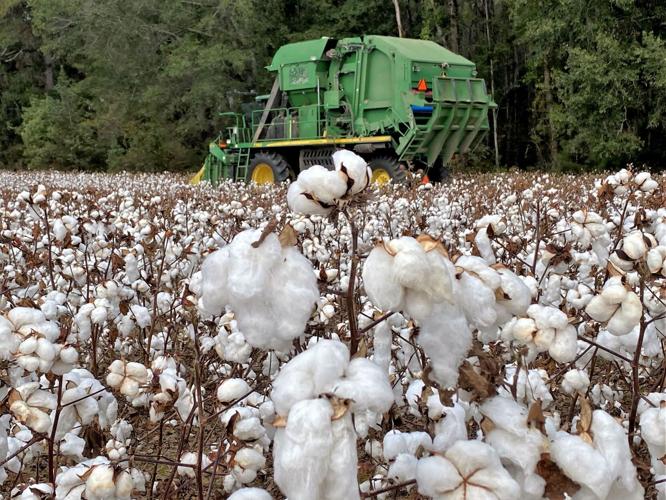
There was more cotton planted in the county this year as compared to 2021. There were approximately 35,000 acres of cotton planted. In 2021, about 25,000 acres were planted.
"The cotton crop varies widely in yield potential across the county due to weather-related issues," Croft said. "There were areas that were extremely dry and then extremely wet in the county during the 2022 growing season."
Croft said it was too early to determine crop yields at the time of this writing because there were a lot of acres still to harvest.
Croft did note that periods of extremely dry conditions in certain areas hurt the crop.
"Heavy rain during the summer in some areas also hurt the crop," he said. "There was also a couple weeks of cloudy wet weather in late August/early September that caused boll rot and hard-lock issues in cotton when it first started to open."
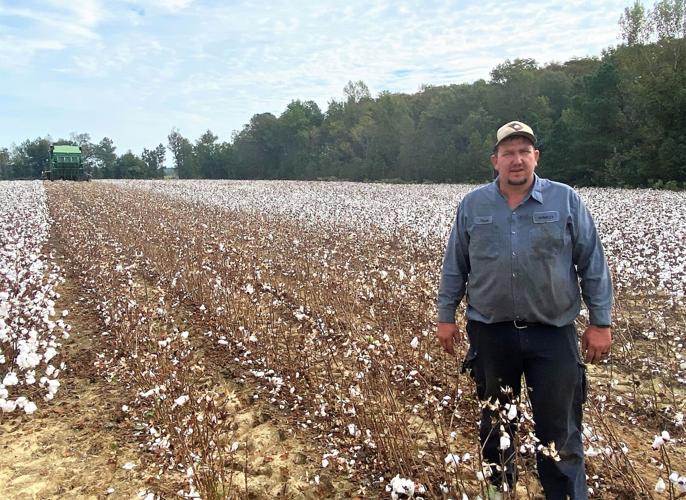
Wimberly said the cotton crop "looks pretty good" in early pickings.
About 100 acres of the Hutto's cotton was irrigated.
"We have not harvested any yet, but the hurricane definitely took the crop from awesome to average," Hutto said.
At the time of this writing, cotton was trading at 83.4 cents per pound.
"This is compared to prices of well over a dollar per pound during the growing season," Croft said.
Lower prices come with higher inputs.
"There was a significant increase in production cost, making it challenging," Croft said. "If you are expecting average yields, prices need to be over a dollar per pound."
Cotton saw normal insect pressure but disease was more of an issue.
"Cotton saw increased foliar diseases in some areas due to wet conditions," Croft said. "Also saw increase in boll rot in cotton opening in late August/early September."
Soybeans
Soybean acres increased compared to 2021. There were approximately 18,000 acres planted. In 2021, about 15,000 acres of soybeans were planted.
As of the middle of October, the crop had yet to be harvested.
"I expect yields to be average to a little below average when you look at the county as a whole," Croft said. "However there are areas that will have above-average soybean yields."
Dry weather negatively impacted soybeans in September, most likely cutting down yield potential, though in some fields, timely rains in late August/early September helped the crop.
Wimberly described his soybean crop as "fair" and "about average."
At Hutto's farm, about 100 acres of the soybean crop was irrigated.
"We have not harvested any but they look great," Hutto said at the time of this writing.
Prices on soybeans were trading around $13.90 bushels per acre. Soybeans in 2021 were trading in the $12.20-a-bushel range.
"Like other crops, cost of production was increased, but not as much, since nitrogen fertilizer is not required for soybean production," Croft said.
Insect pressure for soybeans was heavy, Croft said.
"There was heavy pressure in the 2022 growing season from foliage feeding caterpillars," he said. "Stinkbug pressure was about average."
Disease pressure was average to below average during the 2022 growing season, Croft said.
Hemp
Croft said hemp is a crop that generally has not caught on in Orangeburg County.
"There is a small amount of acres compared to other crops and interest to expand the acres is not there at this time," Croft said.
Clemson Extension Clemson Extension Agent David B. DeWitt, who is over new and emerging crops like hemp, said generally the crop has had a challenging time taking off due to the lack of a lucrative market.
There were about 23.56 acres grown in Orangeburg, about .46 acres in Calhoun for flower and some for transplants, and no acres grown in Bamberg County this year, according to the Farm Service Agency.
DeWitt said the entire state had 164 acres certified with the Farm Services Administration.
There were about 25 permitted growers in the area, including several working with South Carolina State University, DeWitt said.
S.C. State has a 100-acre research farm in Olar in Bamberg County where it grows different varieties of hemp and tests the hemp for its usefulness in a variety of everyday products.
"As with all farmers this year, increased input costs made what was already an expensive crop to grow even more of a burden," DeWitt said. "Some of these acres are irrigated but the hot, dry spell in June made it difficult to get the young transplants started as setting time is normally around June."
"The market for flower and biomass is still very depressed," DeWitt continued. "Most growers seem to be growing for themselves to direct market, or have a niche planned to sell too."
"Many growers have a small amount of plants, less than an acre in many cases," DeWitt said. "The new surge in hemp seems to focus on the other aspects of the crop, a shift from cannabinoids to fiber and grain."
"The acres are not there yet but much market influence is trending that way," DeWitt said.
There are some signs of growth and interest, DeWitt said.
A hempcrete building conference was just held in Charleston earlier this month and a new fiber plant is set to open in Lumberton, N.C., DeWitt said.
"Acres are down as everyone feels out the market and some of the new groups get their plans together," DeWitt said. "Farmers found that we could grow crop fairly well, but needed someone to buy, and several companies have plans including BrightMa Farms. But where this leads to growers gaining acres, I have yet to see."
The Charleston-based company announced in May it was planning to build a $25-30 million hemp research and production-innovation center and create 30 new jobs on 85 acres on Farnum Road, located off Columbia Road north of Orangeburg.
The company is currently partnering with S.C. State’s 1890 Research and Extension to make the project a reality.
The 85-acre tract will include multiple units that will revolve around a state-of-the-art breeding program.
The property will include both indoor and outdoor facilities, laboratories, greenhouses, and processing and breeding facilities.
The center will use genetic mapping and sequencing to develop plants for various uses, such as medical products, clothing and gas. BrightMa is partnering with Switzerland-based Puregene.
The company is also utilizing artificial intelligence technology to change certain farming practices and is making automation easier, including watering plants with the tap of a phone.
The innovation center is expected to be completed and built out within the next year, but research and development are ongoing.
In mid-October, SC Canna LLC also announced its plans to build indoor growing operations in Clarendon County at the Clarendon County Industrial Park in Manning.
The company’s $8.8 million investment is projected to create 37 new jobs.
SC Canna, a subsidiary of Sirius-A-Bioscience, is an integrated grower and distributor of medical-grade hemp products. Founded by native South Carolinians, the company specializes in aeroponics, which allows hemp to be grown indoors from seed to wholesale.
The 50,000-square-foot commercial space will house the company’s proprietary growing system. Operations are expected to be online in 2023.
Hemp was grown for the fifth straight year in Orangeburg County.
The federal Farm Bill signed into law in 2014 approved the growth of hemp for research purposes in the states that allow it.
S.C. Gov. Henry McMaster signed the bill into law in May 2018 making it legal for farmers to grow the crop.
State law allowed the issuance of only 20 permits for farmers statewide to grow 20 acres apiece in 2018.
In 2019, 114 farmers across the state grew hemp.
The law defines industrial hemp as any part of the plant with a THC concentration that does not exceed .3% on a dried-weight basis. Anything above that is considered marijuana and is illegal in the state.'
Overview
According to the 2017 Census of Agriculture, Orangeburg County is home to 978 farms consisting of about 293,790 acres. The average size of a farm is 300 acres. The agriculture census is conducted every five years.
These numbers are down from the 2012 census of 1,056 farms but up in the average farm size. The 2012 census reported an average farm size of 268 acres.
The 2017 numbers bucked a decade-long trend of smaller farm sizes.
Overall, Orangeburg County ranked second in South Carolina in total market value of crops and livestock and poultry sold at $213.9 million in the 2017 census.
The county has a total of 726 cropland farms consisting of about 165,516 acres.
Orangeburg County ranked first in the state in market value of crops sold at $107.2 million.
The county ranked first in the state for the most cotton sold at $22.2 million and first in total sales of other crops and hay at $22.3 million.
The county's largest crops in planted acres in descending order are corn, cotton, peanuts and soybeans.
The agricultural census data is taken every five years.
According to the United States Department of Agriculture National Agricultural Statistics Service, the census will be mailed out to farmers in November 2022 with a response deadline of February 2023.
The census data will be released in the spring or summer of 2024.
In this Series
2022 T&D Fall Farming Edition: Harvest time in S.C.'s breadbasket

Gene Zaleski
T&D Staff Writer


