
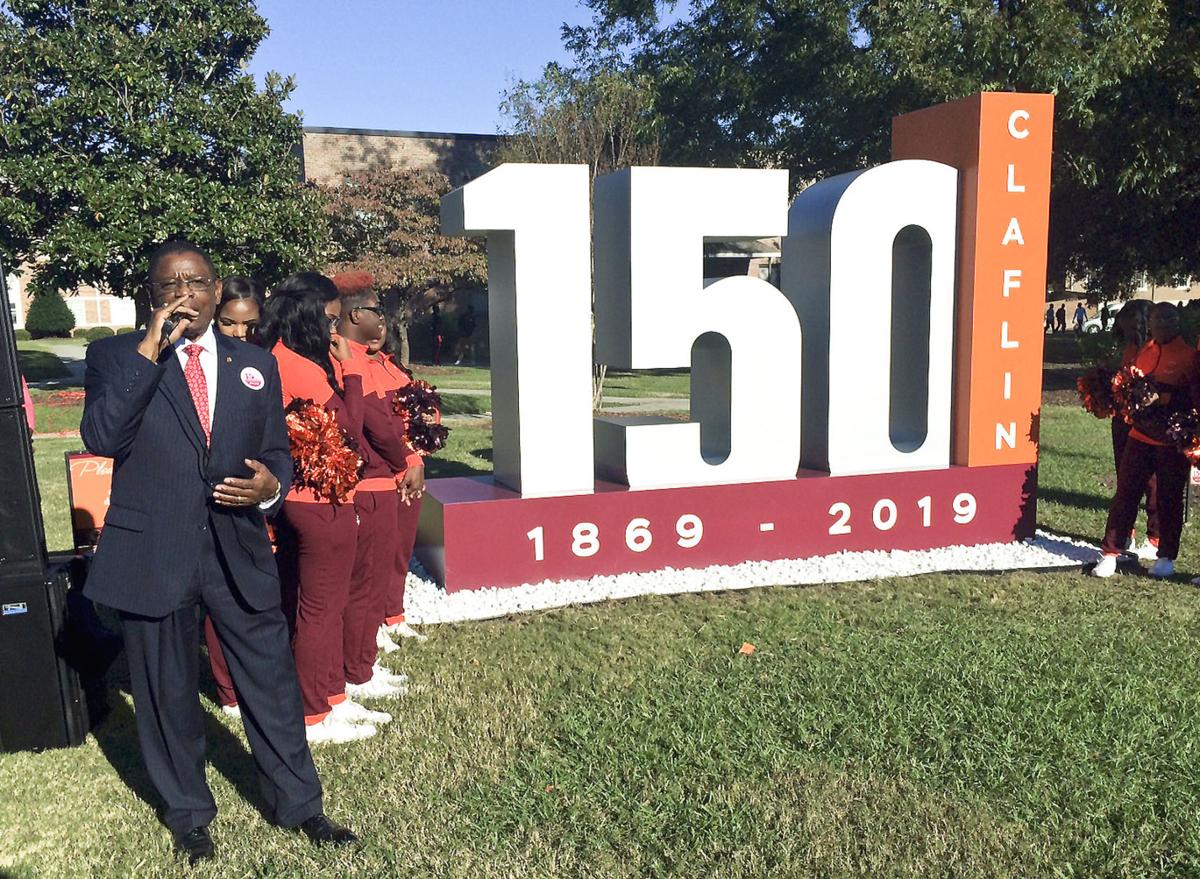
Claflin University kicked off the celebration of its 150th anniversary during Homecoming and Founders’ Day activities.
“This weekend will, of course, be a weekend when we have alumni back on campus, we’ll have members of our board of trustees … supporters, students,” President Dr. Henry N. Tisdale said during the November homecoming kick-off event. “And we thought it would be a good time to really do this kickoff for this really special university.”
Past presidents addressed the crowd and the keynote speaker was Orangeburg artist Dr. Leo Twiggs. A graduate of Claflin’s art program, Twiggs is also the university’s longtime artist-in-residence.
But there are many things that occurred as part of the observance including the Presidential Scholarship Gala. The first gala was actually held in observance of Claflin’s 125th anniversary, and the school has continued the tradition each year since then.
People are also reading…
Founded in 1869 for the education of freedmen and their children, Claflin’s mission was inclusive from the start, Tisdale said.
“Claflin has a very impressive history, beginning with the founding of the university 150 years ago, when the university was established that would invite students without discriminating,” he said.
“That was unique: The first institution of higher learning in the state of South Carolina that opened its doors to all regardless of race, color, creed, ethnic origin or religious philosophy.”
This also holds true for how Claflin appoints its board of trustees, presidents and faculty, he said.
“You will find throughout the history a unique history of diversity and inclusion,” he said. “I think that in itself distinguishes Claflin from every other university in the state of South Carolina.”
There are other things that set Claflin apart, he said, like “the fact that the university made a commitment to uplift, to educate African Americans in particular, so that they could become leaders within their communities.”
When the school was first founded in 1869, it was organized as a degree-granting institution, which distinguishes it from many other colleges and universities, Tisdale said.
“There are many other colleges and universities which may have an earlier founding date, but when you look very closely at when did they become a degree-granting university, the date changes,” he said.
“Claflin, from day one, had the structure to educate college-trained individuals,” he said. And Claflin created leaders from the beginning.
Two students were in the first graduating class in 1882, he said.
“One of them went on to become an MD, a very prominent MD in Texas, Nathaniel Middleton, related to the Middleton family that we know in Orangeburg today,” he said.
“And the other graduate was William Bulkley, who went on to become one of the first black PhDs in the country. In fact, he was the third African American to receive a PhD from a college or university in the United States -- and his PhD was in Latin.”
Bulkley went on to work in New York and was one of the organizers of the Niagara movement, which led to the creation of the NAACP. He was also an organizer of the National Urban League.
“The early graduates were prepared to be leaders in the community,” Tisdale said. “If you look at the early graduates, of course, they were preachers leading churches throughout the community, they were educators leading programs throughout South Carolina. They were attorneys, getting PhDs, working in higher education.
“All of these were graduates coming from an institution that was organized to create leaders, to develop people with college degrees. I think that’s unique.”
Tisdale said that Claflin was the first institution in the state to have a formal art department and also educated some of the first black architects in the nation.
“When you look at the curriculum of Claflin, it was not one or the other, it was a blend in a way. Because on the one hand, you had presidents who emphasized the liberal arts, the humanities, the arts,” he said.
Other presidents emphasized using the hands with trade programs.
“So Claflin’s curriculum was one that was a little different -- it developed a person who could think and it also developed persons who could use the hands,” he said.
The university also has a tremendous economic impact on Orangeburg in the services and products purchased in the community, the residents employed by the school and in the earning power of its graduates, he said.
“This institution today continues to be a great asset for our community and continues to be an economic engine and driver for the well-being -- economic well-being -- of Orangeburg.”