

Orangeburg County industries and manufacturers continued to hum in 2022 and into 2023 despite inflation, rising interest rates and the looming threat of a recession.
Some even expanded operations, and there were others announcing they would locate their operations in the county.
The year -- from April 2022 through April 2023 -- represented about $248.8 million in announced capital investment and nearly 700 new jobs to the area.

"Orangeburg County has always embraced a rich manufacturing tradition of excellence that creates meaningful opportunities for citizens," Orangeburg County Development Commission Executive Director Merle Johnson said. "We are positioned for long-term sustainable growth as we transition from old-line manufacturing to a new era of advanced manufacturing."
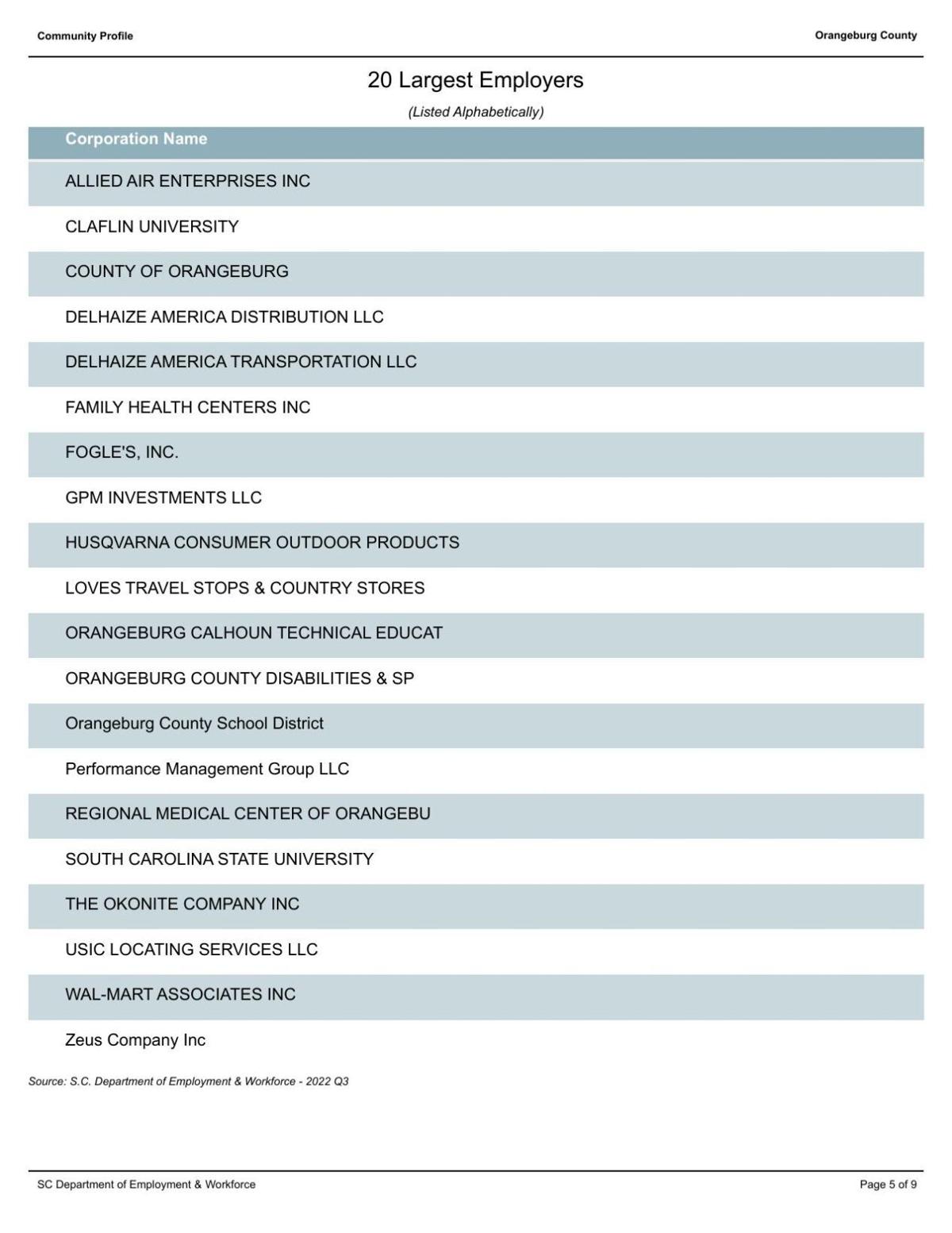
"Our location is home to a diversified economy of over 110 industrial companies with employment largely outpacing growth in other industries," Johnson said. "Over the past five years, 1,629 people were employed as a result of investments totaling over $895 million. Long-thriving industries are key in Orangeburg County’s future economic prosperity."
People are also reading…
Here are some of the highlights of the projects announced in Orangeburg County over the last year.
- Michigan-based Pet Supplies Plus announced plans in August 2022 to invest $53 million and create 275 new jobs over the next five years.
About $37.8 million of the company’s investment will be spent on land and buildings and $15.2 million on machinery and equipment.
The company began operations at its 534,702-square-foot Orangeburg distribution plant in late winter of 2023.
It’s locating in the $25 million building in the Shamrock Commerce Center industrial park on U.S. Highway 301 near Interstate 26.
The Orangeburg plant will be its second largest.
The company distributes dog food, cat litter, cat food, pet toys and decorative clothing for animals.
- Hounen Solar, a global solar panel manufacturer, announced plans in March 2023 to establish its first United States manufacturing operations in Orangeburg County.
The Chino, California, company plans to invest $33 million and create 200 new jobs over the next five years. The Orangeburg County facility will allow the company to manufacture one gigawatt crystalline silicon photovoltaic panels in the U.S.
The company will locate in the Orangeburg County City/Industrial Park at 145 Millennium Drive, where it will lease a 200,720-square-foot facility. The company will locate next to Allied Air Enterprises and across the street from GKN Aerospace.
Hounen manufactures solar photovoltaic panels worldwide. In addition to solar panels, the company creates other electrical products.
- Premium Peanut broke ground in November on its shelling facility in the 1,324-acre South Carolina Gateway Logistics Park in Santee on property it has purchased from DP World Americas, a subsidiary of Dubai World.
Premium Peanut is building its own facilities. It plans to invest $27.5 million in buildings and $36.8 million in equipment in Orangeburg County over the next five years.
The company plans to bring 130 jobs to Orangeburg County.
The company's Santee campus will include a peanut seed treatment facility and the shelling facility. There’s a potential for future expansion.
- Kuntai (North Charleston) Limited Corp., an automotive parts manufacturer, announced plans in July to establish operations in Orangeburg County.
The company’s $1.5 million investment will create 41 new jobs.
Kuntai specializes in car floor mats and is a supplier for high-end, original-equipment manufacturers.
Located at 152 Regional Parkway, Building F, in Orangeburg, Kuntai’s new facility will allow the China-based company to produce floor mats and will be used as a base to further expand its business in the North American market.
- May Renewables LLC announced in February 2023 it was planning to build a $70 million solar farm and storage facility near Cope in Orangeburg County.
The facility will have a 100-megawatt solar farm. It will include a 100-megawatt/400-megawatt battery-energy-storage system.
The farm and storage facility will be built on land located along U.S. Highway 301, also known as Bamberg Road, approximately two miles north of Cope near Carver School Road.
The solar farm will be built on 500 acres, and the batter storage facility will occupy approximately 25 acres. The battery-storage facility will capture electricity, store it as another form of energy and then release it for use when it is needed.
Construction is expected to start in the latter half of 2025 and commercial operation will begin by the end of 2026.
The company is not anticipating the creation of new, ongoing jobs as a result of the project. Construction and maintenance jobs will be connected to the project.
- The ribbon cutting was held in April on the completion of a 125,000-square-foot speculative building at the 1,324-acre South Carolina Gateway Logistics Park.
Dubai-based DP World’s park is located in what Orangeburg County officials call the Global Logistics Triangle, which is the area bordered by Interstate 26, Interstate 95 and U.S. Highway 301.
The company’s 125,000-square-foot spec building is an expandable Class A structure with tilt walls that can be subdivided for smaller users. The building sits on about 22 acres and is expandable to 159,200 square feet.
The park's master plan projects upward of 6.5 million square feet of building space.
- Charleston-based BrightMa Farms announced in April 2022 it was investing between $25 million to $30 million and creating 30 new jobs on 85 acres just outside of Orangeburg.
The company plans to build a hemp research and production “innovation center."
The company broke ground on April 29 for a facility on Farnum Road, located off of Columbia Road north of Orangeburg. The company is partnering with S.C. State’s 1890 Research and Extension to make the project a reality.
The property will include both indoor and outdoor facilities, laboratories, greenhouses and processing and breeding facilities.
The center will use genetic mapping and sequencing to develop plants for various uses, such as medical products, clothing and gas. BrightMa is partnering with Switzerland-based Puregene.
The company is also utilizing artificial intelligence technology to change certain farming practices and is making automation easier, including monitoring carbon monoxide levels and watering plants with the tap of a phone.
The “innovation center” is expected to be completed and built out by the fall of 2023.
- Local farmers will receive federal money to implement "climate smart" production practices through $22 million grant to South Carolina State University.
The grant is from the U.S. Department of Agriculture’s Partnerships for Climate-Smart Commodities
The funding will allow South Carolina State to train ag scholars and agribusiness students to meet the changing demands of the industry.
The five-year project will provide technical and financial support to small and minority peanut, vegetable, beef cattle and forestry farmers. It will aim to measure and verify carbon and greenhouse gas emissions, identify benefits associated with the practices and support markets for the products.
- The S.C. General Assembly in June approved spending nearly $2 billion on the widening of Interstate 26.
That includes expanding a majority of the four-lane interstate to six lanes between Charleston and Columbia. The I-26 widening will include several counties, including Orangeburg and Calhoun.
The state will likely begin soliciting bids at the end of 2023 for a portion of the project to improve I-26 from Columbia.
The widening project has been touted by economic development officials as a key to helping improve the cargo transport for industries and manufacturers.
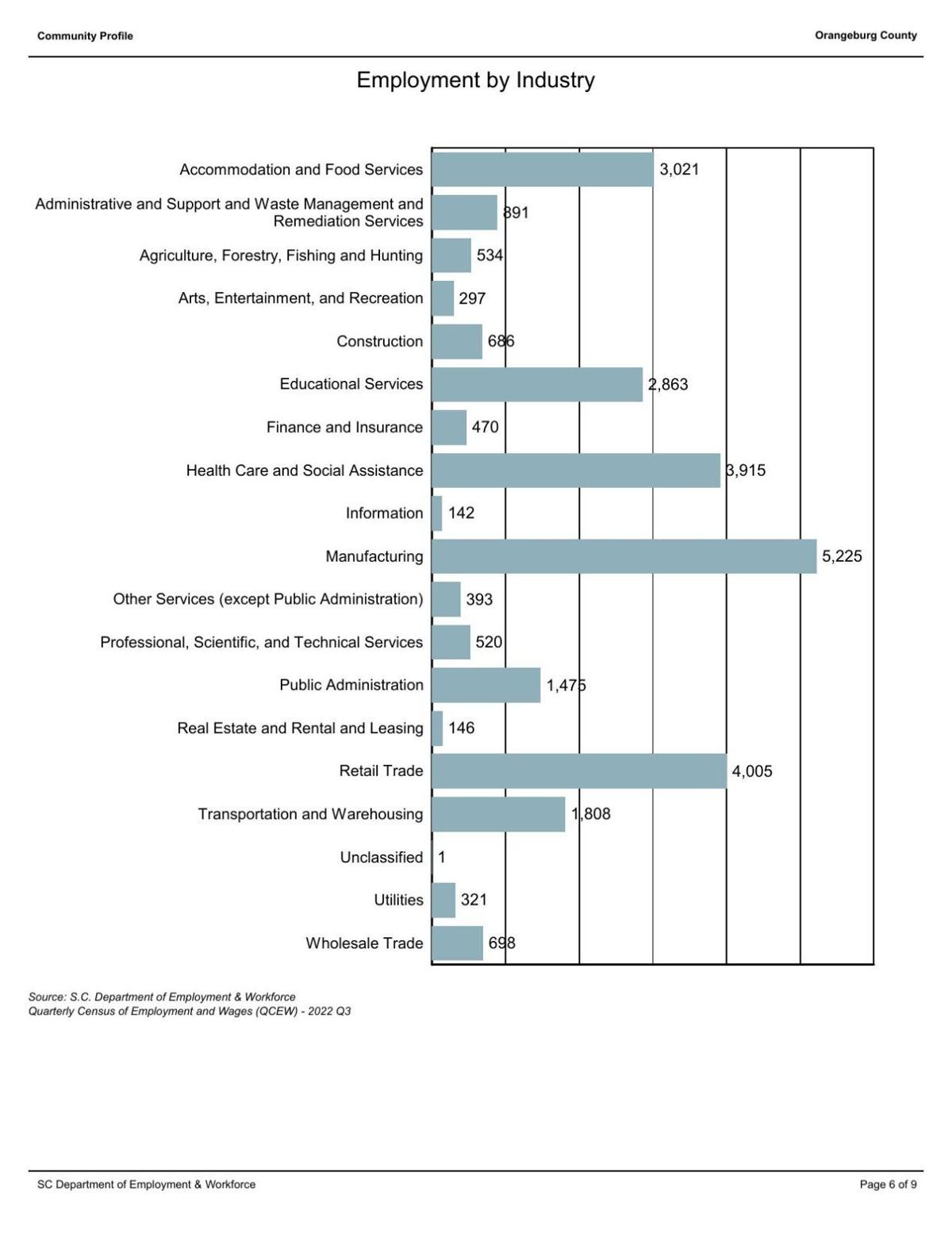
According to the Central South Carolina Alliance, about 18.5% of Orangeburg County's workforce is employed in manufacturing. The Central SC Alliance is a not-for-profit public/private partnership that engages in the recruitment of capital investment and jobs to the Midlands of South Carolina.
CSCA represents the City of Columbia and eight counties: Calhoun, Clarendon, Fairfield, Kershaw, Lexington, Newberry, Orangeburg and Richland. Over 55% of manufacturing employees work for a foreign company.
Economic climate challenging
Tom Barkin, President and CEO of The Federal Reserve of Richmond, which oversees a district that includes South Carolina banks and monetary policy, during an interview in early March on South Carolina Educational Television's "This Week In South Carolina" said the coronavirus pandemic remains from an economic standpoint a factor in the economy.
He said there is still fiscal stimulus in the economy that is being spent and manufacturers continue to struggle to hire workers who are reaping the benefits of stimulus monies.
Barkin said supply chains have improved but there are still challenges of getting chips into cars and supplies continue to be hard to find.
He believes demand will normalize in the coming months, both on the spending and labor fronts, and that inflation will remain persistent with interest rates continuing to be raised in an effort to help slow down demand.
Also appearing on the same SCETV program, "Joey Von Nessen, USC Darla Moore School of Business and state economist, said the ideal scenario would be industries and businesses not seeing quite as much demand so they don't need to hire as many workers. But at the same time, the economy doesn't cool to the point where they actually have to lay any existing workers off.
Von Nessen said the probability of a recession sometime within the next year is around 50% and noted a key trend recently in the state manufacturing sector has been the transition to production of electric vehicles in line with consumer demand.