

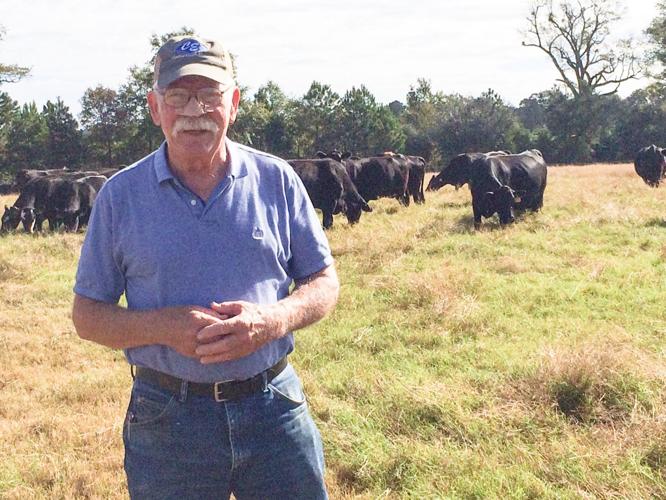
Holly Hill beef cattle farmer Buddy Felder's family comes from a long line of dairy farmers.
Felder was the third generation to follow in his dad's footsteps, getting out to the barn early every morning and afternoon to milk the cows.
But escalating expenses and stagnant milk prices forced the family out of the dairy business 17 years ago.
The proverbial saying that you might be able to take the boy out of the dairy business but you can't take him off the farm holds true for Felder, who has entered into the beef cattle business and currently has about 110 cows at this Branchdale Highway farm near Holly Hill.
He said the story for his cattle farm in 2020 was the coronavirus and its impact on markets.
"COVID shut down packing plants and drove the price down a little bit on us," Felder said, noting there was a "bottleneck of cows ... The calve prices were not real bad, but they were lower than normal. We got some COVID stimulus and it kind of made up for the reduction."
People are also reading…
Felder said prices were about 20 cents off where they should be but began to improve through October. He said prices are now about $1.40, though they have been down to about $1.20 per pound.
Clemson University Cooperative Extension Livestock Specialist Dr. Brian Bolt said Felder's story is the story for many cattle farmers and ranchers as they continue to deal with supply chain disruptions.
"With weekly buyer behavior being erratic and some local markets closing, there were significant price swings," Bolt said. "The U.S. saw temporary loss of several important export markets when the pandemic initially hit."
"COVID had a major impact on processing facilities throughout the U.S," Area Livestock and Forage Agent Nicole Correa said. "With many facilities closing down due to employees who contracted the virus, it limited the number of locations for producers to take their livestock."
"There is now a backlog of appointments with some farmers and ranchers booking appointments in advance through August 2021 in order to ensure that cattle are added to the list in time for processing."
According to data published by the United States Department of Agriculture-Agricultural Marketing Service, South Carolina sale barn prices from January to May were depressed in comparison to 2019 and with respect to the historical seasonal pricing.
"The price discount ranged from 1-10% with respect to 2019 prices," said Matt Fischer, Clemson area agribusiness agent. "From June to current, the prices have rallied and have paid a premium to 2019 prices, still working towards the seasonal expected movement."
According to the South Carolina Department of Agriculture Market Report, in the middle of October, medium and large high-quality feeder steers at the Orangeburg Stockyards sold for an average of $118 per 100 pounds or cwt for a 625-pound steer and $153 for a 332-pound steer.
Fischer said from January to August 2020, the volume of cattle marketed was below the 10-year average statewide.
"The volume moving through sale barns statewide during this time was noticeably depressed to historical expectations," Fischer said. "Since August, we are starting to see volume increase to above historical expectations."
Fort Motte cattleman and past president of the Orangeburg Area Cattlemen’s Association Larry Elmore said market-wise there is a demand for good-quality calves.
"The market wants to have calves that are vaccinated and weaned so that when they guy these calves at 650 to 700 pounds, they won't have any unnecessary health problems," Elmore said. "We have to produce the cattle the market is asking for."
Bolt said the single largest driver of beef prices is demand -- both domestic and international.
"Despite competing proteins being available at significantly lower prices, this year beef consumption has remained strong," Bolt said.
So what does that mean for livestock farmers?
"Profitability varies by operation," Bolt said. "Relatively speaking, prices are strong relative to market fundamentals (supply and demand). Input costs have remained steady throughout the year (feed and fertilizer)."
"Operations that can successfully manage annual cow costs (by keeping them below average) and marketing their calf crop successfully (by selling them above market averages) should be well positioned this year," Bolt said.
Correa said farmers have become creative during this time of pandemic.
"Many farmers and ranchers have explored options for selling freezer beef," she said. "For farmers who are having trouble selling cattle already processed, as a result of longer wait times, it has been challenging to keep up with demand."
"There has also been an influx of individuals purchasing livestock with the intent to finish them out before processing, which allows farmers and ranchers to make a profit on the animal without the uncertainty of doing so themselves," Correa said.
Both Correa and Bolt say feed prices have remained flat year to date.
"There appears to be an ample supply of hay and pasture conditions have continued in a positive direction. With that said, there are always local issues as it relates to amount of hay produced and the local demand, which can cause isolated problems for producers."
In The T&D Region, at least two farmers were dealing with some hay issues.
"It was excellent for the cows but for the hay it was not so good," Felder said. "We had a lot of rain this year and it was hard even though the grass grew well, we did not have the opportunity to cure the hay on time."
Elmore echoed Felder. Elmore farms with his son Ashton near the Fort Motte area. The men have about 50 cows.
"Our biggest challenge was the hay we got like other people came back with hay samples that were lower than desired quality ratings," Elmore said, noting he will have to resort to a more expensive supplement to get the next calf crop off the ground.
In light of all the challenges, Elmore said there is good news as the region once again has an area livestock agent covering Orangeburg, Calhoun and Lexington counties. The area has been without a local livestock agent for several years.
A native of Hawaii, Correa has been with the department less than two months.
Elmore said having a local agent can help farmers with expertise on such things as soil analysis and sampling for hay production.
The OACA has also for years had a desire to have an open and bred heifer sale. He says a local agent can help coordinate such an event. Over the past few years, local cattle farmers have had to drive to Saluda for such an opportunity.
Like many sectors, the cattle industry in the region has generally stabilized after seeing a rather significant decline since the middle 1980s due to rising operation costs that forced many farmers out of business.
In Orangeburg County, the number of cattle and calve farms actually increased from 197 in 2012 to 220 in 2017.
The number of cattle and calves also increased from 11,768 in 2012 to 12,670 in 2017.
Orangeburg County, according to the 2017 U.S. Department of Agriculture Census, ranks eighth in inventory of cattle and calves in the state.
In Calhoun County, the number of cattle and calve farms grew from 81 in 2012 to 101 in 2017. The number of cattle and calves also grew from 2,291 in 2012 to 3,552 in 2017.
The county ranked 33rd in cattle/calve inventory.
Bamberg County also saw an increase in the number of cattle and calve farms from 55 in 2012 to 78 in 2017. The county, however, saw the number of cattle and calves decrease from 6,919 in 2012 to 5,859 in 2017.
The county ranked 15th in the state in cattle/calve inventory.
Dairy
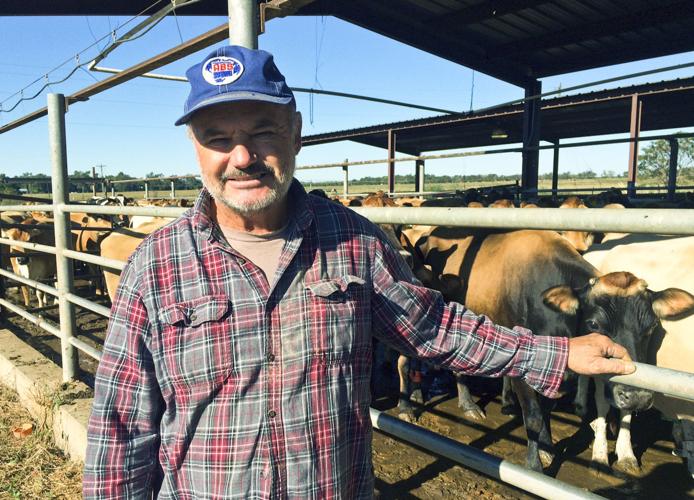
Norway dairy farmer Allen Riddle, a fourth-generation dairyman, milks about 800 cows on 1,300 acres.
Feb. 2, 2020, marked 50 years on the farm for Riddle.
Each year Riddle embarks on another venture in the dairy business and 2020 was a venture he has never seen in his half a century.
Riddle works on the farm with his son, Josh.
"It has been a roller-coaster year," Riddle said, noting the coronavirus has severely impacted the supply chain. "In January, I got the best milk check I have had in years. It looked like everything would be great."
"March came along and corona happened," Riddle said.
Riddle markets his milk through Southeast Milk, which has farmers in Florida, Georgia and South Carolina.
"We sell about 25 loads of milk a day and about 6,000 gallons per load," Riddle said, noting the milk typically goes to schools and cruise ships. "That stopped the minute the schools closed and the cruises stopped."
As a result, for the first time in his 50 years of farming, Riddle had to dump tractor-trailer loads of milk down the drain.
"There was nowhere for it to go," he said, noting for the two months the farm was able to only receive payment on about 90% of its product.
On top of that, the price of milk in March and April also fell, resulting in five-digit dollar losses on the farm, Riddle said.
"There is not the kind of margin there," he said.
Riddle said he was able to provide his product to grocery stores such as Publix, which saw a spike in sales. But "it was nowhere enough to make a difference."
There were some silver linings and a bump in milk prices during the summer to about $20 per hundredweight (cwt) thanks to the federal government stepping up and purchasing some milk and cheese through its food program.
But with many schools and cruise ships still not running, prices have fallen back down to about $15 cwt, Riddle said.
Riddle says if it were not for coronavirus payments, he may have had to fold up his business.
"It helped keep us from sinking," he said. "I used up my savings the last three years staying in business anyways. We will survive."
The U.S. Department of Agriculture Farm Service Agency also has a margin-protection program that works like milk insurance in price supports.
Another silver lining this year has been milk production, Riddle said.
"We have had a great year for crops," Riddle said, noting hay and silage production was "the most we have had in years. We have a great year to produce feed."
COVID halted what had been a generally expanding dairy industry, according to the National Milk Producers Federation.
Cow numbers were growing rapidly in the early part of the year but that growth was halted almost immediately.
In two months, milk production went from a positive 2.8% growth to a negative 0.6% decline, according to the NMPF.
But by August, with rising milk prices again driving some dairy farms to add cows, the industry was back in growth mode.
Cheese production was mostly busy as fall arrived and milk supplies remained plentiful, according to USDA Marketing Service.
Food service continued to increase with pizza orders remaining strong despite COVID-19 restrictions, the USDA states.
Butter production remained active to cover increased baking and year-end festivals. Retail demand has increased as well.
Fluid milk demand remains steady while supplies remain plentiful, according to the USDA.
For the coming year, milk production is expected to increase due to better milk growth per cow.
Annual 2021 forecasts for cheese, dry whey and butter prices are lower, reflecting continued weakness in domestic demand.
The Class III (cheese) price is lowered to $16 per cwt and the Class IV (non-fat dry milk) price is lowered to $13.60 per cwt. The all-milk price in 2021 is also lowered by 5 cents to $17 per cwt, according to the USDA.
Looking forward into 2021, dairy economists expect fluid milk prices to average about $18.30 with less volatility as compared to 2020.
But some analysts say it’s not enough to overcome financial losses over the last couple of years when milk prices got as low as $13 per cwt in March 2018. Milk prices were as much as $24 per cwt back in 2014.
According to the 2017 agricultural census, Orangeburg County ranked second in the number of milk cows at 3,100. The census shows the county has 20 dairy farms.
Despite the decline in dairies over the years, Orangeburg County ranked second in South Carolina in total milk production in 2012 at 48.5 million pounds, according to Southeast Dairy.
The dairy business in Bamberg County, like the rest of the state, has decreased significantly since the 1980s.
There are 10 dairies remaining in the county. Despite this fact, the county ranked third in the number of milk cows at 1,800.
Calhoun County does not have any dairy farmers and has not had any for several years.
The Sandy Run Dairy is situated in the northern part of the county just off Interstate 26 at Exit 125 on S.C. Road 31, but the cows that produce the milk for the ice cream it makes and sells are raised outside of Calhoun County.
Swine
Clemson Extension Associate Farm Management at the Sandhill Research and Education Center Dr. Bernt Nelson noted that as with many agricultural sectors, COVID-19 impacted the swine industry.
"COVID-19 created an unprecedented situation in the swine production industry," Nelson said, noting some areas of the country have seen farrow-to-finish producers see losses as high as $53 per head. By summer, these losses had improved somewhat to about $32 losses per head.
Since July, the swine industry has recovered with prices this year, originally forecast to be 10% lower than 2019, now higher than previously estimated.
"The December futures contract for lean hogs is trading near $70 per hundred weight (cwt)," Nelson said, noting 2021 prices are poised to be better than 2020.
Locally, prices for feeder pigs through the middle of October were $42.50 to $68.33 per head under 100 pounds. Last year prices for feeder pigs were $26 to $43 per head under 100 pounds.
"In July the pork industry, like others, experienced a backlog due to COVID-19," Nelson said. "That backlog is still in existence and is estimated to be at 800,000 animals (nationally). This may seem like a large number at first glance, however U.S. slaughter capacity is near 500,000 head per day."
Nelson noted slaughter plants have been operating on Saturdays so the backlog is only two operation days in total currently.
Demand has also seen a roller coaster ride in 2020.
"Demand for pork, like many other meats, suffered initially, then found itself to be a substitute for beef when COVID-19 caused retail beef prices to skyrocket," Nelson said. "Restaurants closed and meats including pork took a hit."
"In March through July, open-table, seated diners saw a huge drop," Nelson continued. "Since restaurants have begun reopening, we have seen recovery in reservations. However, they are still well below last year. This illustrates the difficulty in the service industry and its effect on pork supply and demand."
International and global issues are also having an impact on local swine.
"China is still feeling the effects of African Swine Fever, which decimated herds in 2019," Nelson said. "Estimates show that China may feel the affects of this for three years through 2021 and into 2022."
"Our biggest purchasers of pork products are Mexico, Japan, South Korea, China, Hong Kong and Australia," he said. "Total commitments to purchase pork products are up 45% as of Oct. 1, 2020, compared to 2019. This will have a very positive influence on pork prices so long as these countries follow through with their commitments."
Feed prices have also been on the rise.
"Corn and soybeans have seen price increases," Nelson said. "December corn futures are currently trading at $4.02. November soybean futures are trading at $10.50. December soymeal futures has increased from $289.5 per ton in August to $367.5 per ton on Oct. 16. These increase in prices will cost producers more to feed their animals."
Another story making news in the swine industry in 2020 is the closing of the Starkey Swine Center near Clemson University by the end of 2021.
The center's closure was touted as needed due to the condition of the facility, available resources and current needs of producers. The center will be repurposed for other agricultural research needs.
Swine's place at The T&D Region table continues to remain small as integration has kept many farmers from entering the business.
The number of hog farms in Orangeburg County remained steady at 48 over the past five years. Those farms had 3,487 hogs in 2017 compared to 24,681 five years before.
This ranked the county fifth in the state.
In Calhoun County, the number of hog farms decreased from 31 in 2012 to 18 in 2017. The number of hogs in the county fell from 16,963 in 2012 to 3,206 in 2017. This ranked the county sixth in the state.
In Bamberg County, the number of hog farms increased from 10 in 2012 to 13 in 2017. The number of hogs declined from 562 in 2012 to 489 in 2017.
This ranked the county 14th in the state.
Texas-based Cactus Feeders, which purchased Orangeburg Foods in 2015, is the only significant swine operation locally.
Swine Graphics Enterprises, a division of Cactus Feeders, breeds, gestates and weans pigs and then transports them to be grown and sold to packers. The company also provides farmers with feed and hogs.
The hog industry is heavily integrated and is controlled by large companies like Tyson and Smithfield, causing many local farmers to get out of the hog business years ago.
Overview
Generally, The T&D Region is among the top agricultural counties in the state.
When looking at the market value of products sold, Orangeburg County had a total of $106.7 million in total sales for livestock, poultry and other products, according to the latest 2017 agricultural census. This ranks the county eighth in the state in the total market value of livestock and poultry agricultural products sold.
Bamberg County had a total of $14 million in total sales for livestock, poultry and other products, according to the census.
This ranks the county 27th in the state.
In Calhoun County, there was a total of $21.8 million in sales for livestock, poultry and other products, according to the census.
This ranked the county 22nd in the state.
Orangeburg County ranked second in sales in milk from cows at $9.8 million, and ninth in the market value of poultry and eggs at $92.4 million.
The county ranked 15th in the state at the market value of cattle and calves sold at $92.4 million.
Orangeburg County ranked eighth in the market value of hogs and pigs sold at $699,000.
Calhoun County ranked ninth in the state in the market value of hogs and pigs sold at $549,000 and 21st in poultry and egg sales at $20.2 million.
The county ranked 30th in cattle and calve sales at $829,000.
The county's milk sales were negligible and listed as $0 in the census.
Bamberg County ranked third in the state in sales in milk from cows at $5.1 million and ranked 15th in the state in hog and pig sales at $94,000.
The county ranked 20th in the market value of cattle and calves at $1.6 million and 28th in poultry and eggs at $7.1 million.