


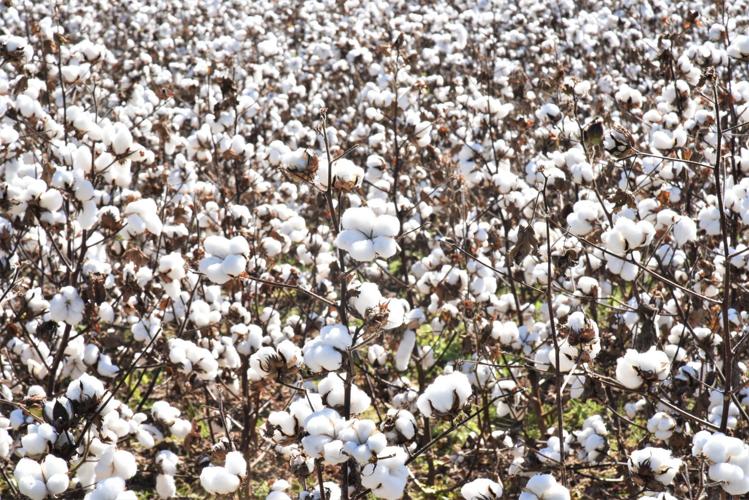
Orangeburg County farmer Jeffrey Axson has a dilemma heading into the 2023 growing season.
"The price of cotton right now is below my cost of production, so it is going to be a last-minute decision on how much cotton is planted," said Axson, who farms in North and Springfield. "We have until late April to make that decision. We got a little while right now."
As of mid-March, Axson said he would like to grow about 300 acres of the crop but he will monitor the prices of cotton over the next month to see where they fall.
What he does know is, "I will plant less cotton this year."
Cotton prices through the middle of March were hovering in the low 80-cent range per pound coming off a year where on average farmers were able to make on average over $1 a pound. Last year, farmers were getting up to about $1.30 per pound for a short period of time.
People are also reading…
Axson said cotton prices need to be around $1 a pound to make the crop profitable for growers.
Axson, however, said he is not too optimistic the price of cotton will increase "unless there is a significant reduction of acres planted."
"There is too much supply and not enough demand," he said. "The demand for cotton has been reduced due to COVID and the financial turmoil in the world. The rising cost of living has people not buying as much clothes."
"China plays a big role in the cotton market," Axson continued. "They have been out of the cotton market lately."
While cotton is the big question mark heading into the growing season, Axson said corn and peanuts are known. He plans to plant about 300 acres of peanuts and 300 acres of corn. He may also grow about 200 acres of soybeans due to the fact that "soybean prices are holding pretty good."
Axson said peanut prices are good currently and he expects the crop to perhaps be the most likely to reap beneficial returns this year due to locked-in contract prices.
The challenge he said is that only so many acres can be planted in peanuts due to peanuts being a poor rotation crop with cotton.
Corn prices were to Axson's satisfaction but he noted they have fallen off in recent weeks. Irrigated corn yields can still be profitable, though, he said.
About 75% of Axson's crops are irrigated.
"Historically, cotton, corn and soybeans are good prices but our inputs are up so much it is eating into our profit," Axson said, noting cotton farmers on average will lose money. "Fertilizer and chemicals have basically doubled in 2022. They are back down some, maybe about 20% from last year."
But Axson said since inputs doubled last year, going down 20% is not where they need to be.
"We need them to get down significantly," he said. "That is the biggest problem -- inputs -- chemicals, fertilizer, parts and equipment."
And of course the annual wild card: the weather.
"Hopefully the weather will cooperate with us," he said.
Axson is just one farmer among many across the county taking stock of market variables as they begin assessing planting decisions for 2023.
"Some of the main points for the 2023 crop will be input cost, potential availability of some input products and current commodity prices," Orangeburg County Clemson Extension Agent Jonathan Croft said. "With cost of nitrogen and some fertilizer materials coming down some from 2022 prices and with the current commodity market price outlook, I think we will see farmers planting less cotton and more corn in Orangeburg County and in SC during 2023."
The driving factor in more corn and less cotton can be seen through future prices.
Croft is optimistic that input costs will continue to fall during the growing season.
"Fertilizer prices have come down some and are expected to come down a little more," he said. "Chemical and seed inputs are down some but all are still up compared to pre-COVID times."
Corn and cotton
James Traywick, who farms in Cope at Frog Level Farms, echoed Axson's sentiments.
"We are planting less cotton and more corn," Traywick said. "The cotton is down and just does not return compared to the corn."
"The cotton makes the least contribution to the bottom line the way prices are at the moment," Traywick said. "The recession talk and interest rates are hurting cotton as well as the slack demand for cotton."
Traywick is planning to plant about 500 acres of corn and 500 acers of cotton.
"It could be a pretty good year if the corn price holds up the way it is now," he said. "Hopefully, it will come back because the stocks are down on corn."
Traywick said dry weather in South America has impacted the corn market. Corn benefits in demand due to the need for animal feed, though corn exports also may be hurt by recession and high interest rates.
Through the end of February, September futures for corn were $5.87 per bushel while December futures for cotton were about 84 cents per pound.
Corn prices last fall were hovering around $6.92 a bushel. Cotton in the fall of 2022 was hovering just under 84 cents per pound.
In 2022, approximately 28,000 acres of corn were planted, which was a drop off from the 40,000 planted in 2021.
There were approximately 35,000 acres of cotton planted. In 2021, about 25,000 acres were planted.
Peanuts
Peanut contracts are better this year than last, Croft said.
"I have heard of some contracts in the high $500 to low $600-per-ton range," Croft said. "At this time, contracting of peanut acres is not complete."
Contracts were approximately $500 per ton for peanuts in 2022. Prices in 2021 were running at about $525 a ton.
About 9,000 acres of peanuts were grown in Orangeburg County last year as compared to about 11,000 the year before.
Soybeans
November futures for soybeans were $13.52 per bushel. Last fall, they were trading for about $13.90 per bushel.
About 18,000 acres of soybeans were planted last year compared to 15,000 the year before.
"Futures prices are lower than they were on this same date (Feb. 28) in 2022," Croft said.
More detailed crop-planting projections will be available later in the spring as the U.S. Department of Agriculture’s National Agricultural Statistics Service contacts producers to determine their plans for the growing season.
USDA survey results will be published in the Prospective Plantings and Quarterly Grain Stocks report.
Croft said while sometimes a new year will mean new farming laws and regulations, this year is the status quo.
"Farmers should have checked their property tax notices as the exemption for farm structures should have been in place on the most recent property tax bills," he said.
Mother Nature is always a question.
Forecasts for April call for warmer temperatures and near-normal rainfall.
Earlier in March, Croft did have a word of caution for growers, especially as many are excited about early springtime temperatures and are "itching to plant."
"I would recommend that farmers and home gardeners procced with caution since we are not out of the window of a potential frost/freeze just yet," he said.
Hemp
Clemson Extension Clemson Extension Agent David B. DeWitt, who is over new and emerging crops like hemp, said there has been a shift in hemp production.
"The focus is moving away from floral production (CBD) towards fiber and grain," DeWitt said. "I think that some growers have established their floral markets and will continue at that level but not much room for growth at current demand levels."
"Processing is still an obstacle for hemp; establishing a solid supply chain will be key to expanding acres in the future," DeWitt said. "Applications for hemp-grower permits are down this year but some that had permits the last couple of years were not actively growing."
DeWitt said overall he expects less growers and acreage in 2023 than in the past few years.
"Buyers are still hard to find," he said. "There are still some interests with a few companies around the Orangeburg area, and SC State will be working with them and their research farm in 2023."
S.C. State has a 100-acre research farm in Olar in Bamberg County where it grows different varieties of hemp and tests the hemp for its usefulness in a variety of everyday products.
Charleston-based BrightMa Farms in May 2022 announced it was building a hemp research and production “innovation center” on 85 acres just outside of Orangeburg on Farnum Road, located off Columbia Road.
The company said it would build a $25-30 million facility and create 30 new jobs.
The 85-acre tract will include multiple units that will revolve around a hemp-breeding program.
The center will use genetic mapping and sequencing to develop plants for various uses, such as medical products, clothing and gas.
The center is expected to be completed and built out by November 2023.
There were about 23.56 acres grown in Orangeburg, about .46 acres in Calhoun for flower and some for transplants, and no acres grown in Bamberg County last year, according to the Farm Service Agency.
Twenty-five permitted growers were in the area, including several working with South Carolina State.
Statewide, about 164 acres of hemp were certified with the FSA.
There are signs of possible growth.
A new fiber plant announced last year it was coming to Lumberton, North Carolina, and in mid-October 2022, SC Canna LLC announced its plans to build indoor growing operations in Clarendon County at the Clarendon County Industrial Park in Manning.
It will be the sixth straight year that hemp can be grown.
The federal Farm Bill signed into law in 2014 approved the growth of the crop for research purposes in the states that allow it.
S.C. Gov. Henry McMaster signed the bill into law in May 2018 making it legal for farmers to grow the crop.
Both hemp and marijuana stem from the same plant species, Cannabis sativa; however, they differ in concentrations of tetrahydrocannabinol.