

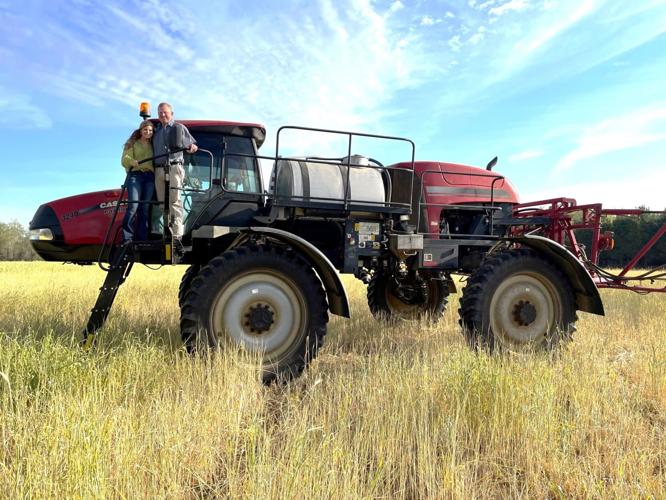
Bamberg County farmer Mary Katherine Harrington comes from a long line of farmers.
"I'm the sixth generation of this farm," Harrington said. "It started with my great-great-great grandfather, Francis Marion Bamberg."
"I'm one of two daughters, and my sister's a hairdresser," Harrington said. "So I knew my sister had no interest in coming back here, but it's just something that I've loved my entire life.
Harrington, along with her husband, Madison, took over the farming operation -- B&B Farms of Bamberg --when her dad, Henry Frederick "Bubba" Bamberg IV, retired.
This year the couple is planting about 650 acres of cotton and 300 acres of peanuts -- a slight change from what they planted in 2022.
The driving factor for the Harringtons in their planting decisions is input costs in relationship to yields. This is coming off a year where the couple saw record high inputs.
People are also reading…
Inputs are not much better this year.
"Some things are coming down, but they're taking their sweet time," Madison said. "Cotton seed's up higher than it was last year. So a lot of people are even trying to come up with different ways to not put as much seed in the ground."
This is called "skip row production," referring to one of the new ways cotton farmers are using to keep their current yields steady while cutting down on expenses.
"It's not something we'll be participating in, but some of our fellow farmers in the area did it last year," Mary Katherine said. "And with the heavy rains we got towards the end of planting last year, it actually really helped the cotton quality."
Another issue are the cost of equipment parts.
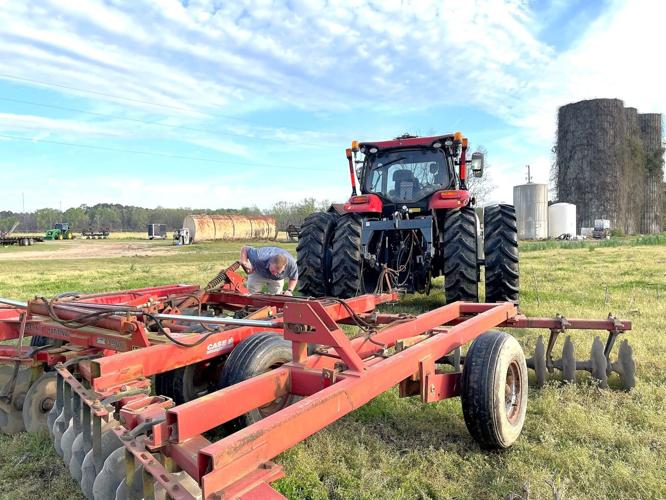
"Parts are something that have really been getting harder and harder to find," Mary Katherine said. "These machines are so special and high maintenance that you just can't go to any parts store and buy the part that you need replacing. It has to come from this certain manufacturer."
"We drive hours," Mary Katherine continued. "I drove down to Waynesboro, Georgia. It's about a 2-1/2-hour ride there and then 2-1/2 back during harvest season last year to get a part because no one around here had it."
"Parts are really getting scarce, and it's scary," she continued. "I don't know if people just all need them or they're hoarding them. It is scary when something tears down on the cotton picker and you've got 500 acres left and a hurricane is on the way. What choice do you have other than to get in the car and go?"
Good yields are also a priority for the couple.
"Depending not only on the quality of the variety of cotton, but we want it to yield heavily because we just don't want the market to be our biggest factor," Mary Katherine said. "The price of cotton is in the low 80s at the moment. So the price is definitely not where it was last year at this time. So we need to make the yield in the field so that we can have more to market if we're going to have to market it at a lower price."
So how does the couple contend with the high inputs and expected lower commodity prices?
"We definitely shop around on our inputs," Mary Katherine said. "We reach out to every seed and chemical company in the area and get prices from them so that we can make sure that we're getting the most competitive price."
"As far as peanuts, we'll contract those peanuts so that the price is locked in for the year once we get it, and we're not shocked at harvest when it's not that price," she continued. "A little bit of forward selling on cotton is a huge part of it. If the prices rally pretty high during the growing season and the cotton looks like it's doing OK, and we think we're going to make a bale to the acre, or whatever it may be, then go ahead and lock that price in for those bales."
"We try to avoid cutting inputs as much as possible just because we know we need to make yield, but it is hard to weigh increasing the inputs and risking your margin," Mary Katherine said.
Beyond high input costs and low market prices, the couple are also concerned about the issue of labor and wildlife impact.
"We have full-time employees," Mary Katherine said. "Our employees are year-round just because we don't have the option to bring in part-time help."
"It's really hard to find good part-time help that's willing to come in and work four months out the year at planting and harvest," she continued. "So our guys are year-round. We're very thankful for that, but it's definitely a seasonal job, for sure."
"Deer pressure is still a major concern in Bamberg County for crops," Mary Katherine said. "That determines a lot of people's planting decisions. A lot of farmers around here don't even try to grow soybeans because they know they're just going to get mowed down by deer."
"We're fortunate to not have hogs right now, but we have a lot of fellow farmers that do," Mary Katherine said. "Deer and hogs are probably the biggest issue around here."
Ehrhardt farmer Andrew Carter raises cattle and will be producing a corn crop at his farm. He will have about 17 acres of corn and that is it this year.
He used to plant more peanuts, corn and soybeans, but the deer, wild hogs and high interest rates caused him to cut back.
His planting decisions typically are related to the "cost vs. the market."
"I've got to put up, say, $1,000 an acre," Carter said. "I don't know if I'm going to get any of that back. So, yes, I have it insured, but the insurance will basically only cover maybe your out-of-pocket. Fertilizer and feed, and that's going to be it," he said.
He said "high petroleum products are a challenge."
"For an example, you used to get lime spread for $40 a ton," Carter said. "Now it's $70 and $80. The freight to get it here. Freight is involved with us all the way around. That has got a lot (to do with it)."
"Even in ordering parts and things like that," he said, the ease -- or unease -- of that has factored into his planting decisions.
Carter's main concern in addition to Mother Nature and wildlife like hogs and deer that partake of his crops is the market.
"Here between me and my son, we're running around 200 adults (cattle) here on the farm," he said. "Most of them have got babies now. What I'm getting at is that's a lot of steaks, and if the consumer can't buy them because they're scared, or they don't have the money, then we're depending on China and overseas to buy our beef.
"One good thing that's happened that's good for me but bad for them is that Argentina with the foot-and-mouth disease has stopped their feeding, stopped shelfing beef," he said.
Another issue facing Carter is taking care of his cows.
"A concern to think about is -- and you can't blame the companies -- is now we cattle producers are having trouble finding vaccine to give to cattle because the company has been focusing on this other COVID and stuff," he said
The Harringtons and Carter are not alone in having to make tough growing decisions.
"Growers have been left wondering when is the best time to purchase inputs as they slowly come down," Bamberg Farm Service Agency County Executive Director Chris Wallace said. "Due to waiting to get the best prices on inputs, there might be a very strong demand at one time, which will put a strain on the supply system.
"Input prices also play a big role in deciding what plants to crop," he continued. "Inputs are down a little bit compared to last year."
"Fuel is about the same cost as last year but fertilizer prices are down somewhat," Wallace said. "Inputs are still very high. For example, a recent study shows that corn input prices have increased 40% since 2020."
Of course, another driving factor for planting decisions is commodity prices are slightly lower than this same time last year.
"All crops’ profit margins will continue to be razor thin in 2023," Wallace said.
Wallace said while the FSA does not have a crystal ball to determine how many acres will be planted this year, based on crop prices and input costs, cotton acres will probably decrease.
"There will probably be more soybeans and corn acres planted this year," he said. "Peanut acreages are projected to be about the same as last year."
Corn
Corn prices this year have trended downward the last several weeks (now about $7.40 per bushel) but are about the same as last spring’s price, Wallace said.
About 5,600 acres of corn were planted in Bamberg County in 2022, with about a quarter of the total corn crop under irrigation. Corn acreage was down from 2021, which saw about 6,457 acres planted.
Cotton
"Cotton prices are down substantially this year," Wallace said. "Right now cotton price is low to mid 80s per pound, while last spring it was just over a $1 per pound."
About 6,146 acres of cotton were planted in 2022, down from the 6,432 acres of cotton planted in the county in 2021.
Peanuts
Last year peanut prices were $525 per ton while this year peanuts will be $550 per ton.
Peanuts (runner) -- About 2,692 acres of runner peanuts were planted in Bamberg County in 2022. In 2021, about 500 less acres of runner peanuts were planted in Bamberg County.
About 779 acres of Virginia peanuts were planted in the county in 2022. This acreage is up from the 531 acres planted in 2021.
Soybeans
Last spring, soybean prices were about $17 per bushel while this year’s projected price is forecast to be between $13-14 per bushel, Wallace said.
About 4,224 acres of soybeans were planted in 2022, which was down slightly from the 4,598 acres of soybeans in Bamberg County in 2021.
Global impacts
Looking at the global market, Wallace painted a picture of the United States' relationship with China.
He noted in the 2022 fiscal year, U.S. agricultural exports rose to a record $196.4 billion.
Last year, the U.S. exported record amounts of soybeans ($16.4 billion) and the second highest level of corn ($4.8 billion ) and cotton ($2.7 billion) to China.
Two years ago, the U.S. exported $35.9 billion in ag products to China.
The U.S. Department of Agriculture predicts a robust $190 billion in exports in 2023.
"For exports to stay at this level, either China must continue to buy enormous quantities of U.S. agricultural products or the United States must get over its aversion to free trade agreements," Wallace said. "Popular opinion is that neither option is likely in today’s world."
"In a world marked by U.S.-China tensions, China will probably hesitate to rely too much on U.S. farms just as the U.S. will rely less on China’s factories," Wallace continued. "China is currently diversifying its food sources."
New FSA services
Wallace said the FSA has two new programs in place for farmers that will expire June 2.
One is the Emergency Relief Program (ERP) Phase 2.
The program covers losses to crops, trees, bushes and vines due to a qualifying disaster event in calendar years 2020 and 2021.
"Phase 2 is a tax-year-based certification program that provides assistance for producers that suffered a loss in revenue due to necessary expenses associated with losses of eligible crops (excluding crops intended for grazing), due in whole or in part to a qualifying disaster event that occurred in the 2020 or 2021 calendar year," Wallace said.
The other program is the Pandemic Assistance Revenue Program (PARP), which provides direct financial assistance to producers of agricultural commodities who suffered at least a 15% loss in gross revenue in calendar year 2020 compared to either 2018 or 2019.
To be eligible for PARP:
- An agricultural producer must have been in the business of farming during at least part of the 2020 calendar year and had a 15% loss in allowable gross revenue for the 2020 calendar year, as compared to the 2018 or 2019 calendar years, as elected by the producer, if they received allowable gross revenue during the 2018 or 2019 calendar years.
Or
- The producer’s expected 2020 calendar year allowable gross revenue if the producer had no allowable gross revenue in 2018 or 2019.
In the interim, the Harringtons will continue to farm because they enjoy what they do.
"We love being able to, I guess, see our outcome and make a difference," Mary Katherine said. "Feeding and clothing the world is huge to us. It (agriculture) is the biggest industry in South Carolina. So we enjoy being a part of it. I work with a lot of incredible farmers. I just think farmers are great people, and we're blessed to be part of them."
Madison agreed with Mary Katherine.
"I like problem-solving," Madison said. "With the equipment side of it, tractors, trucks, whatever you want are getting smarter and smarter. So I'm trying my best in order to be able to fix most everything equipment-wise because obviously that costs. Mechanics are not cheap. I mean that's another input cost."
"The other side is just seeing something grow out in the field that you've planted," he continued. "I just think that is coolest thing in the world."
Looking ahead, Mary Katherine said despite the challenges of farming, they are doing it for their 1-year-old son.
"You do what you gotta do," she said. "Ever since we had him, it has changed the way we do things, for sure. So we want him to be the seventh generation if he wants to be."
Th 61-year old Carter, who has farmed since 1981, has three grandchildren and another on the way.
"I got help coming," he said. "I might not can afford them, might not can keep them here either, but you never know what's going to come about. I don't have the answers. I wish I did."