


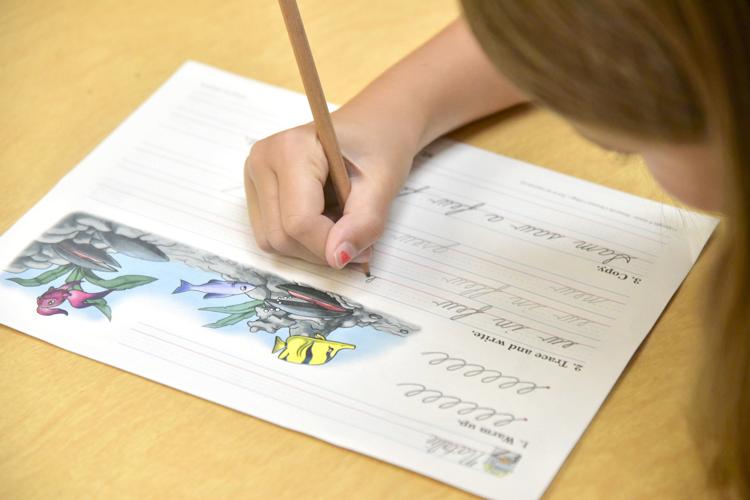
The advent of technology has rendered cursive writing almost obsolete, but school officials say there is value in teaching it as a standard even though a majority of information is now either emailed or texted.
The Back to Basics in Education Act of 2014 requires each school district to provide instruction in cursive writing to ensure that students can create readable documents through legible cursive handwriting by the end of fifth grade.
“Cursive writing requirements for South Carolina students are contained in the rigorous, homegrown South Carolina College- and Career-Ready Standards for English Language Arts written and approved in 2015,” said Ryan Brown, chief communications officer for the state Department of Education.
When the standards were being written by South Carolina educators, state Superintendent of Education Molly Spearman directed them to include cursive writing as it was “a concern she heard from parents across the state," Brown said.
People are also reading…
The Back to Basics in Education Act requires the state Department of Education to assist school districts by providing state-adopted consumable cursive writing student materials. Beginning with the 2015-2016 school year, schools have ordered consumable cursive writing materials for grades 2-5 through the Office of Instructional Materials.
“We begin the instruction of cursive writing during the writing block of ELA (English Language Arts). Our teachers all have consumable books to use to teach the cursive writing," said Jacqueline Jamison, executive director of elementary schools in Orangeburg Consolidated School District 5. "It’s stressed a lot during our writing time because we want it to become a part of the writing process."
She said cursive writing is particularly stressed, for example, when students are writing paragraphs and stories.
“You have to practice with them every year… . At the beginning of the school year, most of our second-grade students are not ready for cursive handwriting. So we wait until later on in the year to introduce it,” Jamison said.
She said there is value in learning cursive.
“I think there is a need for cursive handwriting when it comes to just signing legal documents and even to have the ability to read cursive handwriting. Our role and responsibility is to prepare students for college and careers, and I think we do have to ensure that all of our students can read and write in cursive,” Jamison said.
Penny Sturgill, chief academic officer for grades K4-6th grade in Orangeburg Consolidated School District 4, said the Back to Basics in Education Act is also the template by which children in grades 2-5 are taught cursive.
“This is done during ELA,” she said.
Brown said children who would have not been taught cursive before the standard was put into place in 2015, or who are now in high school, would not be assessed on the requirements of the Back to Basics in Education Act.
“I guess it would depend on what grade they’re in, and then they may get it later. It would solely depend on what it (their grade level) is. But, I mean, if they’re in high school and they haven’t learned it, then they’re probably not going to learn it unless they do that on their own,” he said.
“It’s an elementary and middle school standard and not a high school standard. We don’t go back and retroactively teach things … . If they didn’t learn it at the lower level, then, no, they’re not going to be required to have learned it and be assessed on some things that they did not learn at a lower grade,” Brown added.
LaDan Brown, assistant head of school and curriculum coordinator for Orangeburg Preparatory Schools Inc., said students begin cursive writing in the second grade, with instruction continuing through the first semester of third grade.
“And then after that, those teachers do write their assignments in cursive on the board. They may not ever use it again with all the digital that we have, but I think it’s more or less exposing them to it," she said. "They may come back five or 10 years from now and tell us not to do it at all, but I just think we need to keep the exposure."
Brown noted, “I don’t write good in cursive so I print. But even I, and as old as I am, would still want my child to be exposed to it just in case because a lot of adults still use cursive. They can see and know it if they get a handwritten letter by an adult, or a thank-you note."
Orangeburg Christian Academy Principal Cynthia Poor said cursive writing is built into the independent Christian school’s curriculum.
“We’ve been doing that for a long time. It’s something that we find is effective starting off in the early years. We actually start cursive writing in K5,” Poor said.
“The skill of writing is enforced throughout the elementary years. Once they start with the formation of the letters and they learn how to write, that just carries through, (and students) improve every year,” she said.
OCA Curriculum Coordinator Danielle Newhall said the school begins cursive writing in kindergarten for a reason, and the instruction continues through sixth grade.
“A lot of times if you look at children when they pretend to write and when they color, it’s very loopy. The cursive motion is a very natural motion for them. And, surprisingly enough, it is very easy for them to catch on with the cursive handwriting,” Newhall said.
“And it’s beautiful. We have parents that come in and are shocked whenever they see the kindergarten kids write in cursive. Some of their handwriting is better than adults,” she added.
Newhall said children as early as kindergarten are “like sponges and soak up everything,” and tend to easily learn cursive.
“A lot of schools have taken cursive handwriting out, but all of our historical documents are written in cursive. We have kids that come to us from other schools that can’t even read cursive, that cannot sign their name. So that’s a few reasons why we do the cursive handwriting,” she said.
Jessica Brown, who is in her 12th year as a third-grade teacher at OCA this year, said she is proud to teach cursive and have her students learn it.
“I believe it’s a skill that’s needed. I feel like it’s a lost art. It’s become obsolete because society says we don’t need it because we have so much technology," she said. "And you know what? If you can’t cannot write in cursive, you cannot read in cursive … . I stand firm in what I teach, and I love this curriculum."
Brown’s own 8-year-old daughter, Natalie, will be in her class next year.
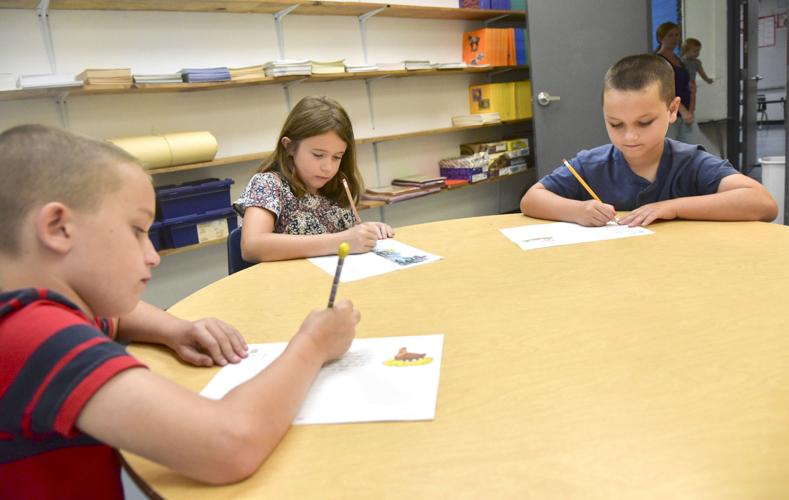
Natalie, along with her schoolmates Caleb Hensley, 8, and Isaac Hensley, 9, say they enjoy writing in cursive.
“I like writing in cursive because it’s easy to learn and it’s pretty. It’s pretty to look at if you take your time,” Natalie said. “I do cursive in spelling class.”
Isaac said, “It feels easier. I know it better, and I feel like it’s a lot more fun to write. I always write in cursive.”
“It’s easier to write for me. I’ve been learning it since 5K,” Caleb said, noting that he writes in cursive the entire school day because “we don’t have a choice.”
Brown said she thinks it’s “sad” that cursive is becoming somewhat of a lost skill.
“With technology, I see more and more of the skills that people possess becoming obsolete. Spelling is no longer needed because of spell check. Cursive writing is no longer needed because everything is either typed out or texted,” she said.
“But whenever I get those kids that have been here since kindergarten and have written in cursive every year, their penmanship is beautiful. It might not always be perfect, but I tell them all the time, ‘You can do something that most adults cannot.'"
Contact the writer: dgleaton@timesanddemocrat.com or 803-533-5534. Follow "Good News with Gleaton" on Twitter @DionneTandD.

DIONNE GLEATON
Staff Writer


