


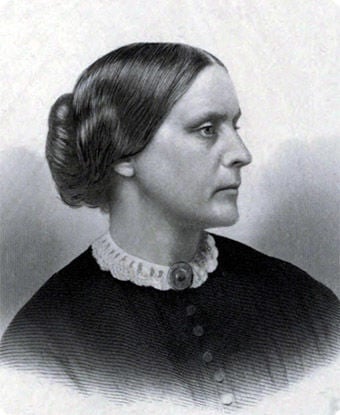
Susan B. Anthony is perhaps the most widely known suffragist of her generation and has become an icon of the woman’s suffrage movement. Anthony traveled the country to give speeches, circulate petitions, and organize local women’s rights organizations.
Anthony was born in Adams, Massachusetts. After the Anthony family moved to Rochester, New York in 1845, they became active in the antislavery movement. Antislavery Quakers met at their farm almost every Sunday, where they were sometimes joined by Frederick Douglass and William Lloyd Garrison.
In 1848 Susan B. Anthony was working as a teacher in Canajoharie, New York, and became involved with the teacher’s union when she discovered that male teachers had a monthly salary of $10, while the female teachers earned $2.50 a month. Her parents and sister Marry attended the 1848 Rochester Woman’s Rights Convention.
People are also reading…
Anthony’s experience with the teacher’s union, temperance, and antislavery reforms, and her Quaker upbringing, laid fertile ground for a career in women’s rights reform to grow. The career would begin with an introduction to Elizabeth Cady Stanton.
On a street corner in Seneca Falls in 1851, Amelia Bloomer introduced Susan B. Anthony to Elizabeth Cady Stanton.
Meeting Elizabeth Cady Stanton was probably the beginning of her interest in women’s rights, but it is Lucy Stone’s speech at the 1852 Syracuse Convention that is credited for convincing Anthony to join the women’s rights movement.
In 1853 Anthony campaigned for women's property rights in New York State, speaking at meetings, collecting signatures for petitions, and lobbying the state legislature. Anthony circulated petitions for married women's property rights and woman suffrage. She addressed the National Women’s Rights Convention in 1854 and urged more petition campaigns. In 1854 she wrote to Matilda Joslyn Gage that “I know slavery is the all-absorbing question of the day, still we must push forward this great central question, which underlies all others.”
By 1856 Anthony had become an agent for the American Anti-Slavery Society, arranging meetings, making speeches, putting up posters, and distributing leaflets. She encountered hostile mobs, armed threats, and things thrown at her. She was hung in effigy, and in Syracuse, New York her image was dragged through the streets.
Anthony and Stanton founded the American Equal Rights Association and in 1868 became editors of its newspaper, The Revolution. The masthead of the newspaper proudly displayed their motto, “Men, their rights, and nothing more; women, their rights, and nothing less.” Also that year, the Fourteenth Amendment passed, recognizing that those born into slavery were entitled to the same citizenship status and protections as free people. The amendment did not, however, grant universal access to the vote.
Stanton, Anthony and others formed the National Woman Suffrage Association and focused solely on a federal woman’s suffrage amendment. In an effort to challenge suffrage, Anthony and her three sisters voted in the 1872 Presidential election. She was arrested at her Rochester, New York home and put on trial in the Ontario County Courthouse, Canandaigua, New York.The judge instructed the jury to find her guilty without any deliberations, and imposed a $100 fine. When Anthony refused to pay a $100 fine and court costs, the judge did not sentence her to prison time, which ended her chance of an appeal. An appeal would have allowed the suffrage movement to take the question of women’s voting rights to the Supreme Court, but it was not to be.
From 1881 to 1885, Anthony joined Elizabeth Cady Stanton and Matilda Joslyn Gage in writing the History of Woman Suffrage. This extensive work focuses solely on white women suffragists, and does not include any suffragists of color.
In 1890, the National Woman Suffrage Association merged with the American Woman Suffrage Association, which argued for state-by-state enfranchisement of women (among other differences). Elizabeth Cady Stanton was the first president of the new group, the National American Woman Suffrage Association, but Anthony was effectively its leader. Anthony became NAWSA president in 1892. Carrie Chapman Catt replaced Anthony as president of the organization when she retired in 1900.
Susan B. Anthony died on March 13, 1906, of heart failure and pneumonia at her Rochester home. She was buried at Mount Hope Cemetery, also in Rochester.
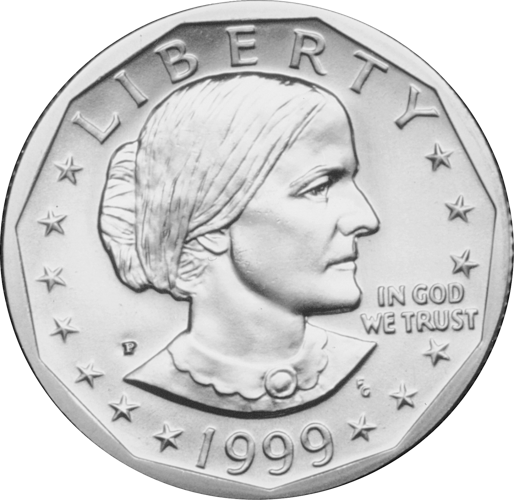
As a final tribute to Susan B. Anthony, the 19th Amendment was named the Susan B. Anthony Amendment. It was ratified in 1920. Susan B. Anthony is also the first non-fictional woman to be depicted on U.S. currency: from 1979 to 1981 and again in 1999, her portrait was on the United States dollar coin.


