
The 2023 growing season saw the arrival of a brand new crop for farmers throughout The T&D Region.
Sesame made its debut, and for local growers who chose to tackle the crop, it was a year of learning, research, trial and error.
After a summer of growth, farmers see the crop's potential viability on the local level as more experience and knowledge are developed on its idiosyncrasies.
Providence farmer Dean Hutto of Hutto Brothers Partnership grew 100 acres of sesame. The Providence community is in the eastern end of Orangeburg County near Holly Hill.
"I call it 'I don't know,' not sesame," Hutto said. "I have no clue what I'm looking at."

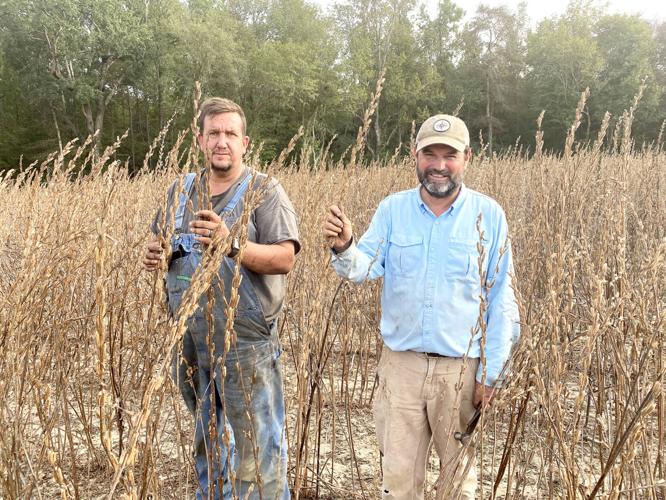
Orangeburg County farmer Pinckney Thompson, left, and Thad Wimberly, right, were among nearly three dozen farmers in The T&D Region to gro…
"It is very hard to get it planted, very tedious to manage ... but I think we have something to harvest if we can get it in the combine because the seed is so small it finds a hole anywhere it can," Hutto said. "I think potentially it's a viable crop option if we get it figured out. I had to replant some and have weeds in all of it, but we are trying to figure it out."
People are also reading…
Hutto joined about 2-1/2 dozen other farmers in Orangeburg, Calhoun and Bamberg counties growing the crop.
The farmers are contracting with Oklahoma-based Sesaco.
Choice Ag of Dillon has served as a receiving point for the harvest and is helping Sesaco with the distribution of seed and coordination of farmers.
Orangeburg County farmer Thad Wimberly, his son Harrison and his father Harry are growing the crop at the family farm on Cattle Creek Road near Branchville.
The Wimberlys planted about 70 acres of sesame under no irrigation. The men have planted a total of 100 acres in the county.

Orangeburg County farmer Pinckney Thompson grew about 100 acres of sesame. There are about 150,000 seeds per pound and 44 pounds is a bushel o…
Thad said the 100 acres of sesame he grew had been desiccated with harvest expected on the verge to begin at the time of this writing. About 70 acres of the crop were not under irrigation.
Thad said how yields will be is anyone's guess.
"We don't know what it will do," he said. "We never had the crop. There is plenty of fruit out there to get."
Thad said a key to how successful the harvest will be is "how the combine handles it."
"We have to make sure we don't have too much loss," Thad said. "We want to get our losses down. They are very, very small seeds."
Orangeburg County farmer Pinckney Thompson, who was working with Thad to grow the crop, grew about 100 acres, half under irrigation. He said adequate rainfall meant he did not need to use irrigation. Thompson's farm is near the Holly Hill area.
"It reminds me of growing cotton in the '90s before Roundup Ready," Thompson said. "In other words, we had to plant it and cultivate the weeds. It was old-timey farming, which I kind of missed."
"This is not a home run crop," Thompson continued. "If we hit a single, we are happy. This is hit-a-single crop."
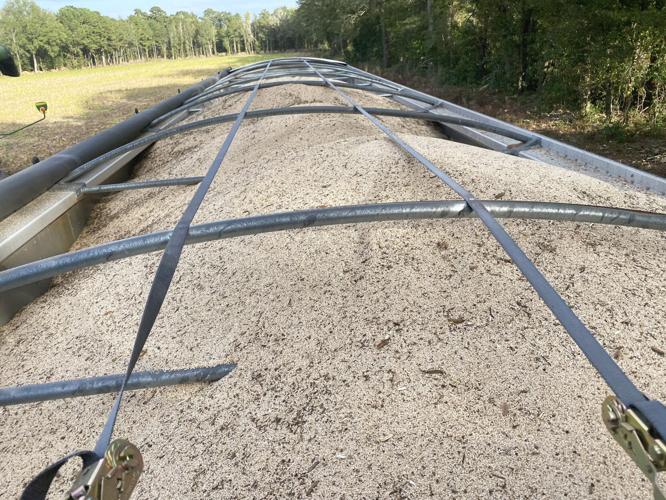
Thad said there are about 150,000 seeds per pound and 44 pounds is a bushel of sesame. The crop is selling at about 60 cents a pound.
"In other words, we are going to get some loss," Thompson said. "The loss is 44 times 60, which would be an acceptable loss."
Thompson said the local crop will be grown primarily for bread products and oil.
"They can't export sesame out of Oklahoma," Thompson said. "So the other potential if it does well in South Carolina and we grow more and perhaps export some out Charleston or Savannah."
As harvest of the crop began in early October, Thad said something new has been learned.
"The header itself is shattering the crop before it gets into the hopper," Thad said. "We are learning. It may be a different type of header that will work better, but there are not many other options from what we got."
Thompson echoed Thad.
"We were told 80% of the loss is going to come through the header and they did not lie to us," Thompson said.
"There is a crop out there in most fields that was planted but with harvest still to go, it is hard to say if it was a successful crop yet," Orangeburg County Clemson Extension Agent Jonathan Croft said.
What is better known is that timely rainfall and the lack of disease and insect pressure did help put a crop in the field, Croft said.
"There were several areas that had too much rain at planting and fields had to be replanted or have a reduced stand due to heavy rainfall at planting," Croft said. "There are also some fields that received too much rain during the growing season and places in fields drowned out. Weed control was a problem in some fields due to the lack of labeled herbicides for weed control in this crop."
Croft said while there was no insect or disease pressure this year, that may not be the case going forward.
"If we were to grow more acres and have a rotation back on to land that had a history of sesame, then we may start seeing some disease pressure," Croft said.
An estimated 4,000 acres of sesame were grown in Orangeburg, Calhoun and Bamberg counties this season.
According to Southeast Farm Press, an estimated 7,000 acres of the crop are expected to be planted statewide. An estimated 13,000 acres are expected to be planted in the Southeast.
Several farmers grew sesame this year in Calhoun County.
"It has not turned out to be a successful crop this year," Calhoun County Clemson Extension Agent Charles Davis said. "Stand issues, heavy rains and disease took a heavy toll on the crop."
The crop in Calhoun County had not been harvested at the time of this writing, so its success or lack thereof was unknown.
Bamberg County Farmer Richard Rentz said he chose to remain out of the crop. The veteran farmer said he will let his two younger sons learn about how to grow a new crop if they so desire to do so.
Bamberg County farmer Mary Katherine Harrington and her husband, Madison, also did not choose to grow the crop. Currently, the couple grows cotton and peanuts and does not have a combine for grains such as corn or beans.
"Somebody outfitted to do that kind of thing, maybe they would be better off with the sesame," Harrington said, noting for her and her husband it would require the investment of additional equipment. "I know a lot of growers were interested in it due to the low input costs and the deer pressure."
In Bamberg County about 96 acres of non-irrigated sesame were planted.
As of the time of this writing, sesame had not been harvested.
Wallace said estimated yields for the crop look to be about 1,000 pounds per acre at 60 cents per pound.
The crop is not completely new to the Southeast. It has been planted in Georgia and in two-year small plot research trials at North Carolina State University.
The crop can be attractive to local growers for a number of reasons.
Some are: deer do not like it; the crop is not a host to nematodes, unlike cotton, corn, peanuts and soybeans; and the crop is low input and high value.
Research testing has shown an average yield would be about 1,000 pounds, meaning that a farmer could make $600 on the crop. On average, farmers have been spending about $200 on inputs, although input costs vary based on farming operation.
Other benefits are that the crop is a scavenger of nutrients, meaning it has a deeper tap root than crops currently grown locally and is more resistant to drought. Also, local farmers can use the same planters and the same combines as they do with their existing crops. The crop also has the same growing season as cotton, peanuts and soybeans.
As to the crop's future place at the table in Orangeburg County, Hutto said he will consider planting sesame again contingent upon a few things.
"If I can get it in the combine, into a truck, delivered and make any money, I will try it again," he said.
Croft said as of early October it was still difficult to speculate on what the future of the crop will be in the county.
"Once we get this crop harvested, we will know if this will be a crop to put into a regular rotation," Croft said.
"The hope is for the sesame is drought tolerance and deer tolerance," Thompson said. "I think we can grow it. If we can harvest it and if it can yield, I think it can be a fit."