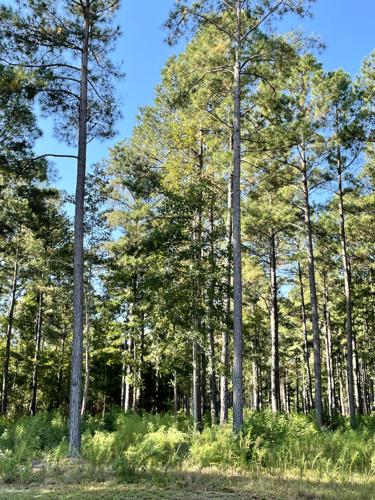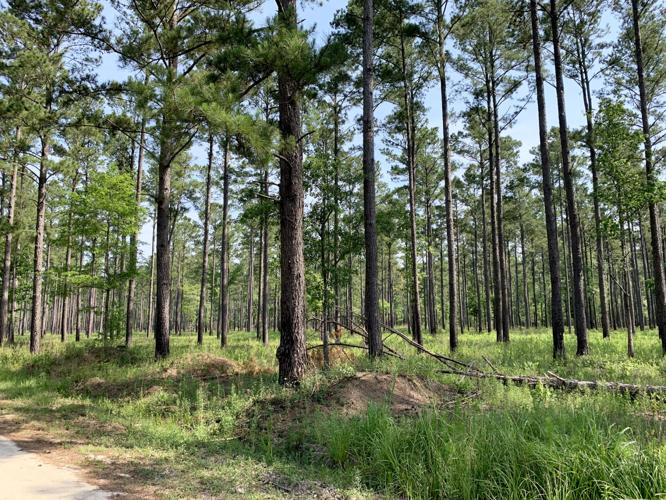

South Carolina's 12.9 million acres of forestland provide jobs, clean air, clean water, wildlife habitat, recreational opportunities, and timber and non-timber resources.
In October 2022, the forest industry in South Carolina celebrated the results of a study from the South Carolina Forestry Commission that reported a $23.2 billion impact from forestry on the state's economy.
However, since the May 2023 announcement of the closing of the almost 90-year-old WestRock paper mill in North Charleston, many questions in the forestry community have been related to the impact on the pulpwood market.
Tim Adams, South Carolina Forestry Commission division director for resource development, said, "The WestRock mill's closure resulted in an average loss of fiber markets for 2.5 to 3 million tons of pulpwood."
Clemson University Cooperative Extension Service Area Forestry and Wildlife Agent Janet Steele says landowners planning a timber sale soon nee…
"Although the mill's feed stock came from multiple states, South Carolina landowners furnished 96% of the fiber," Adams continued. "Softwood made up 71% of the wood going into WestRock's Charleston plant. Eighty percent of the fiber going into the plant was roundwood vs. 20% in the form of mill residues."
People are also reading…
To put into perspective: The mill closure will result in a market loss for over 100,000 pulpwood loads each year.
Fortunately, forest landowners and those in the timber industry in the Bamberg-Barnwell-Orangeburg area have access to pulpwood markets at paper mills in Eastover and Augusta, Georgia.
Also, the purchase of the idled Georgia-Pacific-oriented strain board mill in Allendale by WestFraser in 2021 will provide another market for pulpwood stems.
However, the WestRock mill closure has had recent trickle-down effects on timber prices.
Stumpage prices for pine and hardwood pulpwood, the amount the landowner is paid for their wood, have dropped since the beginning of the year.

Clemson University Cooperative Extension Service Area Forestry and Wildlife Agent Janet Steele says landowners planning a timber sale soon nee…
The statewide average at the end of the second quarter of this year was a little less than $9 per ton for pine pulpwood, and landowners in areas where pulpwood supply is high have reported being offered 50% less for their pine and hardwood pulpwood than a year ago.
The statewide average for pine chip-and-saw and sawtimber has held steady the last year, at about $19 and $24 per ton, respectively. These prices are not expected to increase until the state’s high supply of sawtimber stumpage declines throughout the coming decade.
With growing concern over the impact of the mill closure on forest-management strategies for landowners and land managers, as well as potential new timber markets, representatives from South Carolina’s timber industry, state agencies and the Forestry Association of South Carolina formed the South Carolina Forest Recovery Task Force.
The task force was established to address challenges facing the South Carolina wood-supply chain due to the recent mill closures.
It will focus on increasing the capacity of wood consumption of existing forest product manufacturers in South Carolina and surrounding states. This will include their increase in wood procurement from counties where WestRock North Charleston previously procured timber.
The task force will also focus on attracting new wood product manufacturers to the state.
Landowners planning a timber sale soon need to weigh the decreased stumpage price they may be offered for their pulpwood against the detrimental impacts to their forest of not conducting the sale, particularly if it is a first thinning.
Properly timed thinnings in natural and planted pine stands can generate income, improve habitat for wildlife species, and, most importantly, maintain a healthy, productive forest.
One of the most critical considerations for conducting thinning operations when needed is that it will maintain a healthy forest with a reduced risk of insect attack, primarily from pine bark beetles.
Pine stands that are overstocked and have surpassed the target age for a thinning have less resistance to beetle attack, particularly those on drier soils during periods of extended drought.
While thinning does not guarantee that a pine stand will not be attacked during a bark beetle outbreak, it can lessen the impacts since the stand will grow more hardy trees with less competition for site resources.
Also, thinned stands will have more significant air movement, which dilutes bark beetle pheromones and reduces the attraction of additional insects to the trees.
Fortunately, Southern pine beetle outbreaks have not been reported in the Bamberg-Barnwell-Orangeburg area this year. Ips engraver beetle spots visited this summer typically included five to 10 trees and larger areas of activity like those seen in 2019 were not found.
One of the emerging forest health concerns in South Carolina is the potential impacts of non-native insects.
Dr. David Coyle, assistant professor and state extension specialist for forest health and invasive species at Clemson University, has noted that the spotted lanternfly, which feeds on over 70 different species, can damage a variety of hardwood species and decimate agricultural groups such as tree fruits, berries and grapes.
This insect, native to China, has been found as far south as Virginia.
Another emerging threat is the elm zigzag sawfly, native to China and Japan.
It can severely defoliate elm species and was found in North Carolina in 2022.
The Asian longhorned beetle outbreak in Charleston and Dorchester counties, another non-native invasive insect from Asia, is currently contained in a 73-square-mile quarantine area.
One of the biggest threats to the spread of non-native insects is often moving wood and other materials in or on which eggs, egg masses or cocoons have been laid.
Landowners are encouraged to be familiar with forest insect pests and diseases and periodically monitor their woodlands for these and other forest health concerns.