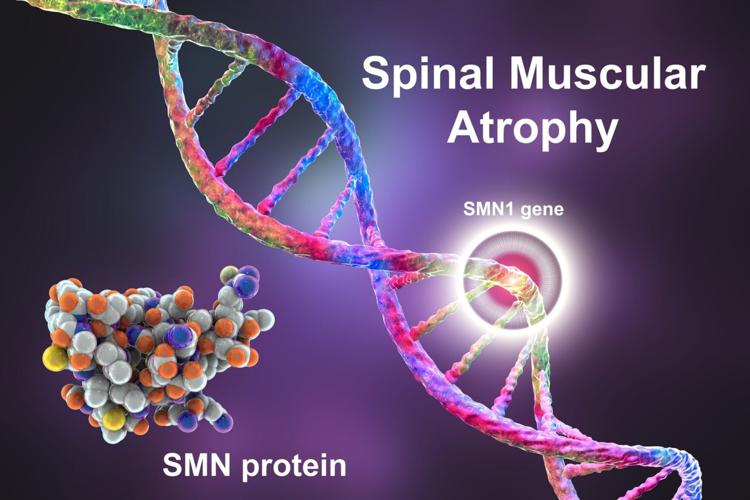
Spinal muscular atrophy, SMA, a genetic neuromuscular disorder with progressive muscle wasting because of loss of motor neurons due to mutation in the SMN1 gene, conceptual 3D illustration
For more than 20 years, Kat Jones saw little reason to visit a neurologist. Diagnosed with spinal muscular atrophy (SMA) as a toddler, she had spent much of her life managing a progressive disease with few treatment options. Eventually, she just stopped looking for answers.
What was the point?
“You weren’t really told anything negative, but you weren’t told anything positive either,” said Jones, now 48.
SMA is a rare genetic disease most often caused by the loss or mutation of the SMN1 gene. Without a functioning SMN1 gene, the body doesn’t produce enough survival motor neuron (SMN) protein, causing the nerve cells that control voluntary movement to degenerate. The resulting muscle weakness and atrophy can affect mobility, swallowing and breathing.
Jones was diagnosed with SMA at 18 months old after she began showing developmental delays. At the time, treatments that could alter the course of the disease weren’t available.
Today, newborn screening can identify SMA before symptoms emerge, allowing treatment to begin while more of the motor neurons that control movement are still preserved. Early detection and treatment can significantly change the course of the disease. But for adults like Jones, who lived with SMA long before these advances, the experience has been very different.
As she grew older and considered what the future might hold, Jones decided to return to neurological care.
“I got back into the loop,” Jones said, “and I’m really glad I did because it was a much different experience.”
A new approach to care
When Jones returned to MUSC’s Muscular Dystrophy Association (MDA) clinic, she met Sarah Breevoort, M.D., Ph.D., associate professor in the Department of Neurology.
The experience marked a turning point for Jones.
“That first time I met her was like a night-and-day experience. It felt hopeful to be seen again,” Jones said. “To be able to relate to her patients, whether they’re 3 years old, 30 years old or 60 years old, is a testament to her and who she is. She actually motivates me not to be scared and try new things.”
This content is sourced from
MUSC Health
. It reflects the author's views and has not been edited by our newsroom. It may have been generated using AI assistance.
Spinal muscular atrophy, SMA, a genetic neuromuscular disorder with progressive muscle wasting because of loss of motor neurons due to mutation in the SMN1 gene, conceptual 3D illustration