


By Megan Pangrass, SCDNR archaeology intern
Experimental archaeology is the art of experimenting with past archaeological methods to reconstruct pre-contact tools and technologies. One might wonder what is the point and why it is beneficial to reconstruct past technologies. It allows archaeologists to answer these questions: How were pre-contact tools made? Why choose a rare material that must be traded rather than a material that is more abundant and local? How long does it take to knap a specific material or type of tool? How did a pre-contact vessel perform during the firing process? The list of questions goes on. However, experimental archaeology may help answer many of these questions.
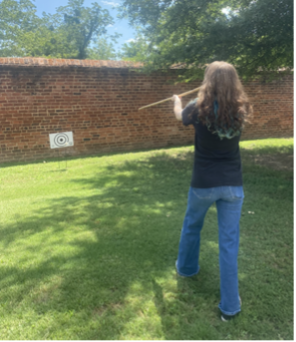
During my archaeology internship with the South Carolina Department of Natural Resources (SCDNR) Cultural Heritage Trust Program, I had the privilege of performing experimental archaeology firsthand. I flintknapped a hand axe made from chert on my first try. Additionally, I knapped a chert projectile point from a discarded flake. I crafted my own blowgun darts, using wooden sticks, thistles and string. I experimented with a handmade bow and arrows, atlatls and spears, and blowguns and darts. The day was filled with adventure, intrigue and excitement. More importantly, I was able to draw conclusions about why experimental archaeology is so beneficial in proving or disproving archaeological hypotheses. However, this realization came at the end of a journey.
People are also reading…
Initially, I was handed a bamboo skewer with a slit in the tip, a dried and bound thistle flower, and a long string in hopes of making a blowgun dart. Using the string, I carefully wrapped the tip of the stick, using the slit to hold the string in place. I wet the string with my tongue and placed the end of the string in between my lips. Turning the stick clockwise, I slowly wound the string around the end of the thistles, watching the thistles wrap around the stick. Before I knew it, I tied off the string and I had a dart, unusable unfortunately, but a dart. I now understood the effort that goes into the manufacturing process and how much time and raw material are needed.
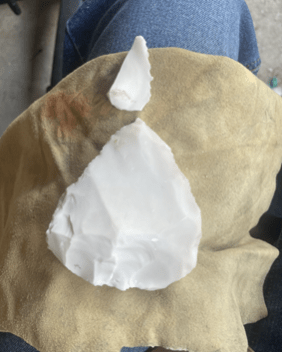
In my next project, I was handed a large chunk, or core, of chert. Chert is a type of rock native to South Carolina, and the piece I was given was about the size of my palm. I was told to try my best to create a tool. In the honor of transparency, I immediately started whacking away with a copper hammer-like tool called a billet. I hit too high and I did not even create a flake, a small, discarded chunk of stone detached from a core. Then I hit too low and half my core shattered beneath me. Although I was having immense fun whacking away at the stone in my hand, I knew I had to come at it from a different angle. I looked for edges in the stone, striking it at an angle to create smaller, more purposeful flakes. After a few carefully calculated whacks, the shape gave way. I created a three-sided, almost triangular shape with a point at the top and two rounded bottom corners. I later learned that I created a tool akin to a pre-contact hand axe. The process of creating my own stone tool revealed some answers to the questions I once had. I now know the process of making stone tools with this type of material and how long the process can take. I understand the benefits of choosing a good raw material like chert to work with based on its durability, hardness and predictability in the stone’s fracturing.
Experimental archaeology allows us to answer both technical questions about a tool’s manufacturing process and hypothetical questions about an individual’s choices during the manufacturing process. It can also allow archaeologists to bridge a gap to the past in hopes of better understanding past cultures and processes. Hands-on activities such as the one I participated in aid students like me and the public in understanding history, making archaeology more tangible.


