
United Way of Greater Charlotte launches regional effort to better understand financial hardship and drive solutions
41% of North Carolina households struggle to afford the basics, new ALICE data shows.
CHARLOTTE, N.C. — More than 4 in 10 North Carolina households cannot afford the basic cost of living, according to newly released data from United For ALICE®. The findings reveal that financial hardship extends far beyond what traditional poverty measures capture and highlight a growing challenge facing working families throughout the Greater Charlotte region.
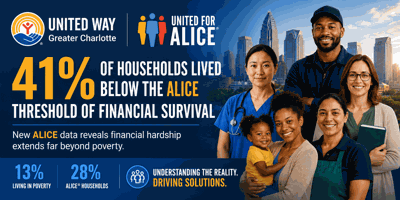
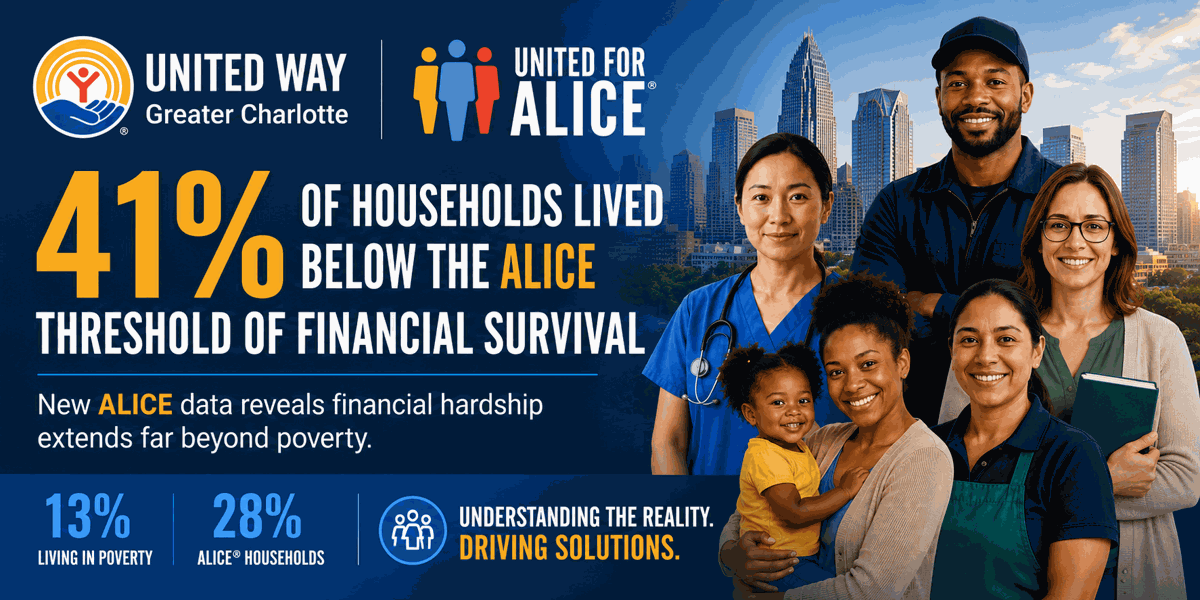
The 2024 State of ALICE Report for North Carolina found that 41% of households lived below the ALICE Threshold of Financial Survival, meaning they did not earn enough to cover essential household expenses. While 13% of households were living in poverty, an additional 28% were classified as ALICE: Asset Limited, Income Constrained, Employed.
People are also reading…
These are households earning above the federal poverty level but still unable to consistently afford necessities such as housing, child care, food, transportation, health care and technology.
“Many people assume financial hardship only affects households living below the poverty line, but the data tells a different story,” said Kathryn Firmin-Sellers, president and CEO of United Way of Greater Charlotte. “Across our region, hardworking families are doing everything right. They’re working, contributing to our economy, and raising families, yet they still struggle to afford the basics. ALICE helps us better understand their reality and take action.”
The report reveals a widening gap between wages and the cost of living. In 2024, a North Carolina family of four needed approximately $79,596 annually to meet only the most basic household expenses. By comparison, two adults working full time in common occupations such as a cook and a bank teller earned a combined income of just $70,052, leaving a nearly $10,000 gap between earnings and survival costs.
The findings also underscore the limitations of the federal poverty level, which was established using a methodology developed in the 1960s and does not account for local costs of living. In 2024, the federal poverty level was $31,200 for a family of four, less than half of what many North Carolina families actually needed to get by.
United Way of Greater Charlotte is leading the launch of the ALICE framework across the region to help communities better understand the true scope of financial hardship and align around solutions that strengthen economic stability.
The ALICE data shows that households below the threshold exist in every county, every demographic group and every major industry. They include child care providers, retail workers, food service employees, health care aides, delivery drivers and countless others who perform essential work while struggling to make ends meet.
“ALICE households are the backbone of our communities,” Firmin-Sellers said. “When working families cannot afford housing, child care, transportation, or health care, it affects all of us. Understanding ALICE allows us to make smarter investments, strengthen nonprofit partnerships, and advocate for solutions that help families build stability.”
As the driving force for collective change, United Way of Greater Charlotte is convening business leaders, nonprofit organizations, elected officials, researchers, philanthropists and community members around shared data and evidence-based solutions.
The organization believes that improving outcomes for ALICE households creates benefits that extend throughout the community, including stronger schools, healthier families, a more resilient workforce and a stronger local economy.
To learn more about ALICE and explore county-level data, visit UnitedForALICE.org/North-Carolina.
About United Way of Greater Charlotte
United Way of Greater Charlotte is the driving force for collective change, strengthening nonprofits so communities can thrive. Serving Mecklenburg, Cabarrus, Union and Anson counties, United Way invests in solutions that improve economic mobility, education, health and community well-being. By bringing together residents, nonprofits, businesses, government leaders and philanthropists, United Way works to build a Greater Charlotte where everyone has the opportunity to thrive.
About United For ALICE
United For ALICE is a U.S. research organization driving innovation, research and action to improve life across the country for ALICE® (Asset Limited, Income Constrained, Employed) and for all. Through the development of the ALICE measurements, a comprehensive, unbiased picture of financial hardship has emerged. United For ALICE partners convene, advocate and collaborate on solutions that promote financial stability at local, state and national levels. For more information, visit UnitedForALICE.org.