
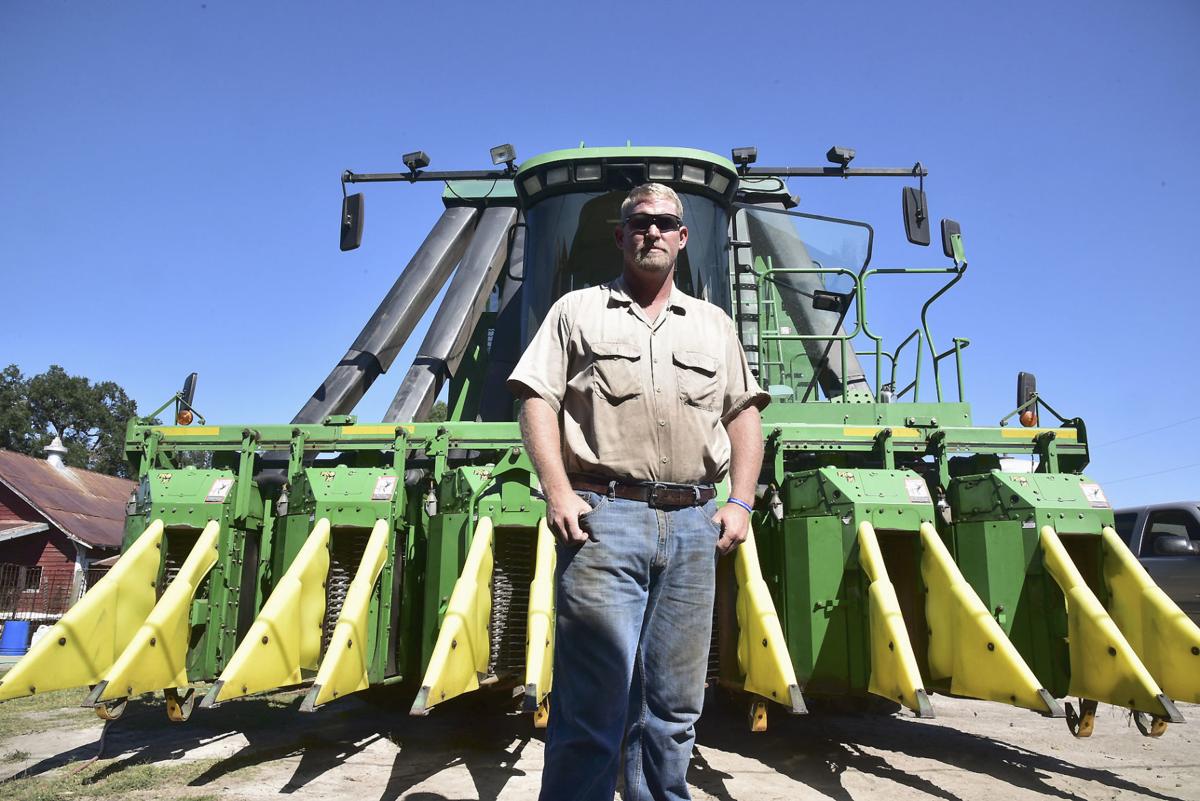
Orangeburg County row crop farmer Edwin Smoak began farming about 16 years ago.
He says 2016 was more of a typical year after a 2015 that saw damaging droughts and historic floods.
"We did better than last year but it was not a great year," Smoak said. "I would call it a fairly normal year, to be honest with you."
Smoak grew about 300 acres of corn, 600 acres of cotton and 200 acres of peanuts in 2016. All his crops are dryland.
Yields will most likely be average across the board for Smoak although average yields will be hard pressed to offset low commodity prices. Corn is seeing prices the lowest they have been in recent memory as supplies are flooding the market.
Orangeburg County Clemson Extension Agent Jonathan Croft said overall, the year was decent.
People are also reading…
"I would say that so far it has been better than last year," Croft said.
In 2016, irrigated corn saw a drop-off due to heat, cotton struggled to produce abundantly due to two tropical storms, soybeans and peanuts were average but suffered from summer heat and drought.
Smoak and farmers across the region once again saw Mother Nature's worst in October with Hurricane Matthew in 2016.
The storm damaged cotton bolls across the county, but because of the brevity of the storm and its dry aftermath, farmers were able to sustain the storm's blow better than the prolonged 2015 drought.
Providence farmer Dean Hutto planted about 1,400 acres of soybeans and 350 acres of peanuts. He had harvested both crops by the time Hurricane Matthew arrived, and he has harvested about half of his 450 acres of cotton.
Unlike the the October 2015 flood, Hurricane Matthew only dumped about 13 inches of rain on his farm, Hutto said. About 18 inches of rain was responsible for the flood.
Hutto said while he would describe the year as average, he is thankful for something to show for this year.
"I did not harvest any peanuts or cotton last year," he said.
As 2016 comes to an end, Hutto says he is looking forward to 2017 and hoping for a better October 2017 than the last two Octobers.
Despite the challenges thrown at farmers by the weather, Croft noted Orangeburg County continues to remain a state leader in agriculture as it ranks first in agricultural products sold.
"We also rank number one in acres planted for cotton and peanuts, second for corn and ninth for soybeans," he said. "Animal agriculture is also big in Orangeburg County. We rank in the top five in most categories of animal agriculture that is measured by the Census of Agriculture."
Overview
According to the latest 2012 Census of Agriculture data, Orangeburg County is home to 1,056 farms with an average farm size of 268 acres.
The number of farms in Orangeburg County has increased from 1,002 in the 2007 census, though the average farm size has decreased from 287 acres in 2007.
The numbers are part of a decade-long trend of smaller farm sizes.
The total land farmed was 283,128 acres. This is down from 287,524 acres in 2007.
Orangeburg County ranked first in total receipts for crops and livestock in the state.
Crops brought in a total of $124.6 million (first in the state) and livestock brought in $106.9 million (fifth in the state).
Agricultural census data is taken every five years.
Corn
Orangeburg County reported between 25,000 to 30,000 acres of corn planted this year.
Dryland corn yields varied depending on planting date and area of the county, Croft said.
"From what I was told by farmers, yields ranged from 35 bushels to 140 bushels per acre," he said. "With the drop-off in commodity prices this year, farmers would like to have seen yields that were higher, especially in dryland situations where the drought and extreme heat caught them at the wrong time."
Croft said irrigated yields were more consistent.
"The variations in yields were based on planting date and management practices at each operation," he said. "From what I was told by farmers, yields ranged from 150 to 285 bushels per acre."
Smoak described his corn crop as "really good."
"We averaged 125 bushels an acre as opposed to 11 bushels an acre from last year," he said. "That is a good number. I am happy anytime that averages over 100 bushels an acre."
Smoak said the crop started out really, really good but summer heat did cut back on yields.
Corn prices, however, are eating into any positive yields, he said.
"I am not sure I can do that," Smoak said when asked if he will break even on the crop this year. "It is about $3.50 a bushel. That is miserable. It has been that low but it has been a good many years since it was that low."
Croft said conditions during corn planting in late March and early April were beneficial, helping early-planted corn.
"Late-planted corn suffered from hot, dry weather that hit in July," he said.
The extreme heat and drought did have a benefit: disease and insect issues were kept to a minimum.
The lower than desired yields are combined with Chicago Board of Trade corn prices at $3.55 per bushel for December contracts.
"At $3.55 per bushel, dryland corn farmers would need to make approximately 140 bushels per acre to cover variable cost of production," Croft said. "It would be nice to see corn prices in the $5.00 to $6.00 range."
Cotton
In Orangeburg County, about 20,000 acres of cotton was planted.
Smoak has about 600 acres of dryland cotton.
He said early estimates are that cotton yields are "okay."
"It looks pretty good," Smoak said. "We had about half defoliated before the storm. It looks better every day."
Smoak said he, along with other farmers, did suffer from Matthew.
"It did blow some on the ground and we did lose some to Matthew," he said.
The crop was also lost to heat.
"We had 15 days of 100-degree heat in a row," Smoak said. "Noting grows in 100-degree heat."
Hutto said his cotton crop was about average.
"I had some really good and some moderate," he said.
Hutto said Hurricane Matthew damaged some cotton.
"I think it is better than I thought it was that Saturday," he said. "When it quit raining and the sun came back out, it looked better."
As harvest had just gotten underway in the middle of October, yields have yet to come in, Croft said, noting he is estimating it will be an average crop. He said farmers would love to see an average of 1,000 pounds of lint per acre dryland and 1,500 plus pounds on irrigated land.
"Wet conditions hurt stands of cotton in some areas of the county back in late April and May when cotton was being planted," Croft said. "For the most part, we got decent plant stands; however, extreme heat and drought conditions during July did reduce yield potential in the county, especially on sandier soil types."
If it was not drought, it was wind. Cotton saw a double whammy.
"Wind and rain from two tropical storms are also going to have some negative impact on yield, but until we really start picking some of these fields that have been blown over by the wind, it is going to be hard to tell how much," Croft said.
While not having any significant insect or disease issues, Croft said there were pockets of spider mites during the cotton growing season.
Cotton prices, like corn, are also down this year.
Prices have hovered at about 60 cents a pound although Chicago Board of Trade contracts have the price up to 70 cents per pound.
"Farmers would like to see 85 cents per pound or higher," Croft said.
"For me, I would like to grow 75 cents to 80 cents cotton," Smoak said. "I think that would be fair market value."
Peanuts
About 15,000 acres of peanuts were planted this year in the county.
Smoak grew about 200 acres of peanuts.
"They did fairly well," he said. "We managed to get all the peanuts out before Matthew hit. That was a real blessing."
At $420 a ton, Smoak said he needs peanuts to be over $500 a ton.
"I am not sure I am going to plant peanuts next year because of the low price. It is not worth the hassle for me," he said.
"Farmers would love to see peanut prices get back into the $600 per ton range," Croft said.
He said early dryland yields and grades vary widely depending on the area of the county and planting dates.
"Irrigated peanuts have been in the 5,000-pound-per-acre range," Croft said.
Hutto's peanuts, which are dryland, produced good yields.
"I don't know numbers-wise ... but they were average," he said. "It is not a stellar crop, but they were better than last year. I did not harvest any last year."
Hutto said he expects to average about two tons per acre of peanuts.
Thankfully, Smoak, like many farmers, sought to spare peanuts from the fury of Hurricane Matthew, Croft said.
"There was a big push to harvest peanuts, and a lot of acres were harvested," he said. "I have not heard what the yield and grades coming in during that time were. The storm did cause us to delay harvesting a lot of runner peanuts, so final yields are still to be determined."
Heat and drought during the growing season as well as harvesting delays from Matthew impacted the crop.
Peanuts suffered from a number of insect issues due to the dry conditions.
"We saw spider mites, wire worm, lesser cornstalk borer and burrow bug damage to pods this year greater than normal," Croft said. "We had more pressure from foliage-feeding caterpillars than we have had in the last couple of years as well."
He said disease pressure was average with some "hot spots of late leaf spot."
Soybeans
About 25,000 acres of soybeans were planted countywide, Croft said.
Hutto has harvested about 100 acres of dryland soybeans thus far.
"They were fair," he said. "I would say they were average or a little bit above average."
Hutto said later rains in August helped the soybeans.
"It was a good growing season," Hutto said. "We had a couple of weeks in July where it was really hot."
Like with cotton, harvest is early for soybeans, but Croft said the crop suffered from drought and summertime heat.
"At this time, I am estimating countywide that we will be average to a little below average," he said. "However, early harvested beans have been good at 35 bushels to 40 bushels average."
Croft said heat and drought in July, along with "heavy deer feeding" in some areas, negatively impacted soybean yields.
The county was spared any significant disease issues, but Asian Soybean Rust was detected, he said.
"It did not arrive in time to hurt soybean yield," Croft said. "Foliage-feeding caterpillars were a problem in some areas this year, and multiple insecticides had to be used for their control."
Soybean prices were also lower than in past years, hovering in the $9-range.
"At this price, growers would have to make approximately 30 bushels to 35 bushels per acre to break even," Croft said.
Wheat
Croft said very little wheat was planted this past year due to the weather, especially the 2015 floods and fall rains.
"I am estimating we have less than 3,000 acres in the county," he said, adding he does not have good estimates on yields for wheat this year.
Wheat prices were in the $4 range, meaning farmers would have to make over 65 bushels per acre to break even on variable costs.
Wheat futures for December delivery rose 2.5 cents to $4.07 a bushel on the Chicago Board of Trade.
Fruits and vegetables
Bowman fruit and vegetable farmer Watson Weathers' farm is about seven miles east of Bowman.
Weathers, who has been growing vegetables for the last 33 years, said he grows vegetables year-round in an effort to limit crop loss.
Generally, he has a spring crop and a fall crop. Potatoes, squash, zucchini, broccoli, collards and green peanuts are typically grown in the spring. Fall crops include collards, turnips, mustard greens and rutabagas.
Weathers said 2016 "has been one of my worst years."
"It was not so bad in 2015 like most farmers," he said, adding, however, that 2015's flood has impacted his 2016 crop. "January, February, March and April collards, turnips, and rutabagas got washed out by the flood. Every time we tried to plant, we could not do anything. We had no income until May."
In May, Weathers said he grew squash, zucchini, red peppers, peas, red-skinned potatoes and broccoli.
"We made a good yield but there was no profit," he said. "The prices on squash and zucchini are terrible."
Weathers said the broccoli was "drowned out."
He is hoping the fall crop "might be different."
"We have decent hand-picked green peanuts for boiling," Weathers said. "They were average."
As of mid-October, Weathers said he was busy cutting collards.
"I have about a 50 percent stand because of a lot of the calamities and the weather. Plants were dying even when we put water on them," he said. "We are going to have a 50 percent yield on collard greens. That is not good at all."
Clemson Extension Commercial Horticulture Agent Lalo Toledo, who has been with Orangeburg County Clemson Extension for two months, says during his time in the county he has been able to see mostly leafy greens such as collards, turnips and kale.
He said countywide, it appears collards saw the largest plantings at about 250 acres, kale about 120 to 150 acres and turnips about 80 acres to 100 acres. He says sweet potatoes (about 1,500 acres) and butter beans (about 20 acres) have also been planted in the county.
"The collards are turning out good," Toledo said, despite the fact that all the leafy greens were the target of a number of pests including the diamond black moth, cabbage looper, imported cabbage worm and harlequin bug. "They feed directly on the economic portion of the crop, which is the leaf. They are direct pests."
He said the imported cabbage worm was the worst pest.
"It is really hard to get a good control because we are talking about caterpillars or worms that are on the underside of the leaf," Toledo said. "It is really hard to get coverage when you are spraying through the top."
Farmers did a pretty good job of controlling the insects and were able to make a crop this year, he said.
Beyond the leafy greens, sweet potatoes this year "are doing really good," Toledo said.
"I thought we would have problems with the flood a couple of days ago, but they were done already by the time the storm hit," he said.
Toledo said the cucumbers and butter beans he has seen have also looked "really good."
Contact the writer: gzaleski@timesanddemocrat.com or 803-533-5551. Follow on Twitter @ZaleskiTD.

Gene Zaleski
T&D Staff Writer